Tag: World War II

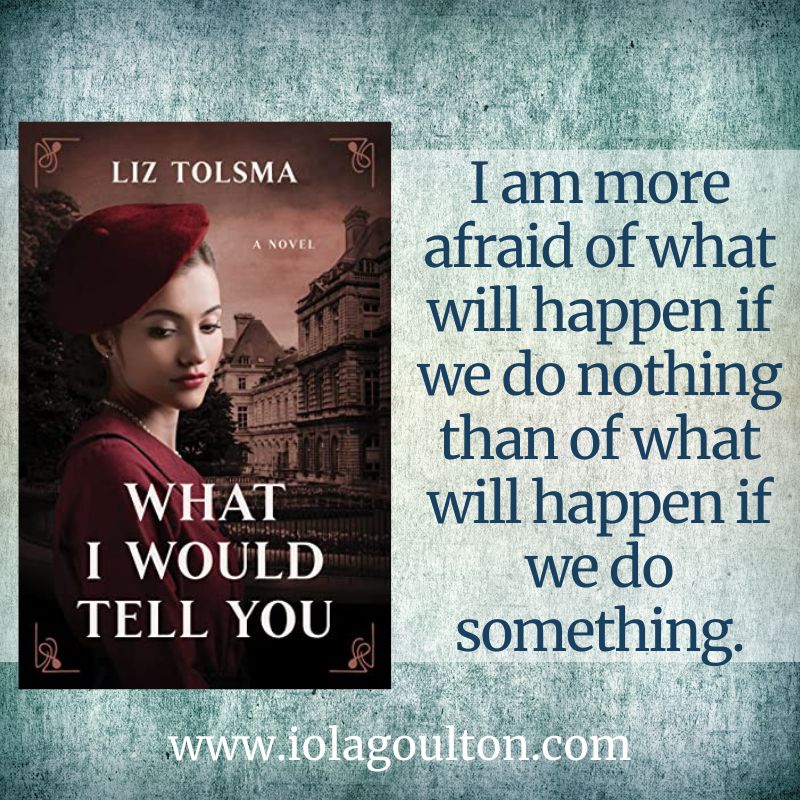
I am more afraid of what will happen if we do nothing than of what will happen if we do something.

Book Review | What I Would Tell You by Liz Tolsma

What I Would Tell You is a dual timeline novel, set in the present and during World War II.

As you can expect, the World War II aspect of the story is not the typical happy-ever-after story I often read and review.

Mathilda Nissim is a Sephardic Jew living in Salonika, Greece, at the outbreak of World War II. She writes and publishes a newsletter for her fellow Jews … an activity she continues at great risk after the Germans invade. She is a quiet leader who is determined that her people resist the Germans so they don’t suffer the rumoured fate of German and Polish Jews.

It’s not hard to see this is going to be the bittersweet part of the story.

Even this introduced two new aspects of history to me. First, the fact there were Jews in Greece (which shouldn’t surprise me given the number of Paul’s letters which are addressed to Jewish-Christian communities in Greece).

Second, I have never heard of Sephardic Jews before. Tolsma explains at the beginning of the novel that the Sephardic Jews were forced to leave Spain in 1492 and scattered across north Africa, southern Europe, and western Asia. Many ended up in in Greece, where this story begins.

One of the things I like most about reading historical fiction is learning new things about history.

In this respect, Liz Tolsma more than delivered. The historical story was strong and fascinating. Mathilda was a great character, and the only problem with reading the historic scenes was that unwanted and uncomfortable foreknowledge of how the story is likely to end (there are very few happy endings for Jews in German-occupied territory of World War II).

Tessa Payton is an American psychology student who undertakes a DNA test and finds she has Spanish and Sephardic Jewish heritage. Her cousin doesn’t … which means they’re not actually related. She decides to go to Thessaloniki, Greece, to see if she can figure out the mystery.

While I enjoyed watching Tessa travel around Greece (and eat all that wonderful Greek food), I found Tessa considerably less intelligent than Mathilda, to the point of being annoying (it is possible to be Jewish and Christian, and we both worship the same God). I also thought there were a few too many coincidences in the current-day timeline. Yes, I know it’s fiction, a made-up story, but it does need to be believable.

What I Would Tell You is a dual timeline story, and I found the past story stronger than the present … at least until the end. The ending definitely ticked all the boxes.

Recommended for fans of dual timeline fiction and historical fiction set in World War II.

About Liz Tolsma
Liz TolsmaPassionate might best describe Liz Tolsma. She loves writing, research, and editing. Her passion shone through in her first novel which was a double award finalist. On any given day, you might find her pulling weeds in her perennial garden, walking her hyperactive dog, or curled up with a good book. Nothing means more to her than her family. She’s married her high-school sweetheart twenty-eight years ago. Get her talking about international adoption, and you might never get her to stop. She and her husband adopted three children, including a son who is a U.S. Marine, and two daughters.

Find Liz Tolsma online at:

Website | Facebook | Pinterest | Twitter

About What I Would Tell You

Determined to resist the invading Nazis, a Greek Jewish woman’s greatest dream has become her worst nightmare, and now she faces an impossible choice whose consequences echo across the generations.

1941—The pounding of Nazi boots on the streets of Salonika, Greece, reverberates in Mathilda Nissim’s ears, shaking her large community of Sephardic Jews to its core and altering her life forever. If only her people would rise up and resist their captors. At great risk to herself and those around her, she uses the small newspaper she publishes to call them to action, all to no avail. Her husband encourages her to trust God to watch over them, but God has once again deserted His people. Amid the chaos, Mathilda discovers she’s expecting a longed-for child. Still, nothing stops the occupiers’ noose from tightening around their necks, and she may have to resort to desperate measures to ensure her daughter’s survival.

2019—College student Tessa Payton and her cousin take a popular DNA heritage test only to discover they don’t share any common ancestors. In fact, the test reveals Tessa is a Greek Sephardic Jew. This revelation threatens her tenuous faith. Always the overlooked child in her family, she empties her savings account and jets off on a journey to Greece to discover where she belongs and which God demands her allegiance. The enchanting curator at the Jewish museum guides her as she navigates life in Thessaloniki, helps with her genealogical research, and loans her a fascinating journal written by a Jewish woman during WWII. Tessa’s search, however, may open old wounds and uncover long-hidden secrets that could fracture her family forever and leave her with more questions than when she started.

Based in part on true accounts of Jews in Salonika, Greece, What I Would Tell You traces two women’s journeys, delving into what faith looks like and where it leads us as they navigate difficult circumstances and impossible choices that have ripple effects across the years.

Find A Picture of Hope online at:

Amazon BookBub ChristianBook Goodreads Koorong

Don’t forget to click here to check out my Amazon shop for my top picks in Christian fiction!

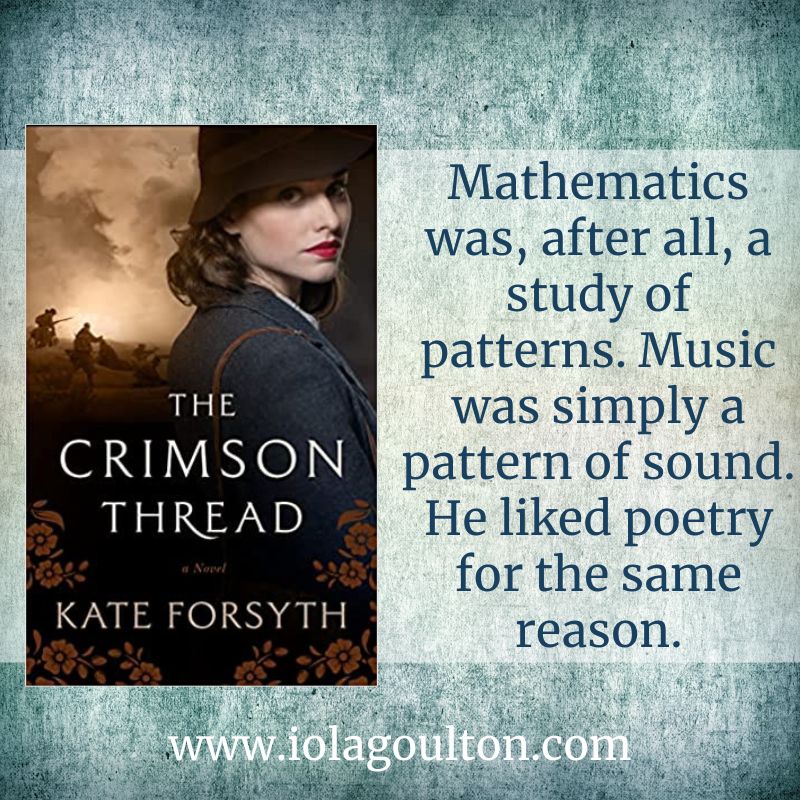
Mathematics was, after all, a study of patterns. Music was simply a pattern of sound. He liked poetry for the same reason.

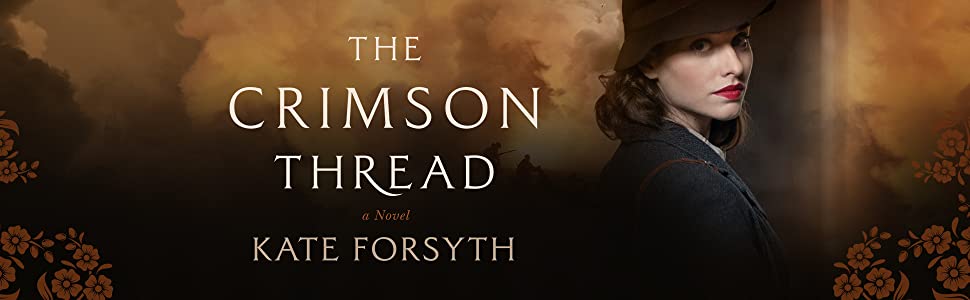
Book Review | The Crimson Thread by Kate Forsyth

I requested a copy of The Crimson Thread for review as soon as I realised it was about the Battle of Crete. My grandfather was in the British Army in World War II, and was on Crete when the German paratroopers arrive. He never talked about his war experiences – I only discovered he was on Crete because I found a map he’d drawn of the British defences.

I was therefore keen to read a fictional account of the battle and the aftermath. As it happened, the Allies famed retreat was over by about a quarter of the way through the book. By then I was so captivated by the characters that I couldn’t stop reading.

Alenka is a translator and guide at the archaeological dig at Knossos (the palace where the legendary minotaur lived), but war has changed that. Her younger half-brother looks like his German father, something he has been bullied for his entire life. So it’s no surprise when he tries to ingratiate himself with the invaders.

Teddy Lloyd and Jack Hawke are officers in the Australian Army. Teddy is the outgoing, popular one, and Jack is loyal sidekick who suffers from a stutter. Both, unsurprisingly, fall for Alenka, although she’s not interested in either of them.

The story takes us all the way through the long German occupation of Crete, and the dangers faced by the locals, and the soldiers who were left behind which the Cretans hid and protected. The story covers years, so it isn’t exactly fast-paced, but it does have plenty of tension. The worst of the tension is relieved by the fact we do know who won the war … but that doesn’t tell us if the characters will survive.

Overall, The Crimson Thread is an excellent World War II novel with a thread of romance. There was one part at the end that I didn’t enjoy because it felt out of character. In hindsight, the scene may have been a nod to the story of Theseus and the Minotaur, so might not surprise or bother those who are more familiar with the story than I am.

Regular readers: please note that The Crimson Thread is not Christian fiction and is not published by a CBA publisher. Having said that, the only scene that didn’t meet the normal standards of Christian fiction was the one at the end that I didn’t think was necessary. #TriggerWarning

Thanks to Blackstone Publishing and Net Galley for providing a free ebook for review.

About Kate Forsyth

Kate ForsythDr Kate Forsyth wrote her first novel aged seven & has now sold more than a million books worldwide.  Recently voted one of Australia’s Favourite Novelists, Kate Forsyth has been called ‘one of the finest writers of this generation’. She has written more than 40 books, for all age groups and across many genres, published in 20 countries.

Kate’s doctoral exegesis ‘The Rebirth of Rapunzel: A Mythic History of the Maiden in the Tower’ won the Aurealis Convenors’ Award for Excellence in 2016 and the William Atheling Jr Award for Criticism in 2017. She was recently awarded the prestigious Nancy Keesing Fellowship by the State Library of NSW.

Named one of Australia’s Favourite 15 Novelists, Kate has a BA in literature, a MA in creative writing and a Doctorate of Creative Arts in fairy tale studies, and is also an accredited master storyteller with the Australian Guild of Storytellers.

She also runs a literary & writing retreat in the Cotswolds every year, as well as retreats on writing True Life Stories and a Mythic Creativity retreat.

Find Kate Forsyth online at:

Website | Facebook | Instagram | Twitter

About The Crimson Thread

In Crete during World War II, Alenka, a young woman who fights with the resistance against the brutal Nazi occupation, finds herself caught between her traitor of a brother and the man she loves, an undercover agent working for the Allies.

May 1941. German paratroopers launch a blitzkrieg from the air against Crete. They are met with fierce defiance, the Greeks fighting back with daggers, pitchforks, and kitchen knives. During the bloody eleven-day battle, Alenka, a young Greek woman, saves the lives of two Australian soldiers.

Jack and Teddy are childhood friends who joined up together to see the world. Both men fall in love with Alenka. They are forced to retreat with the tattered remains of the Allied forces over the towering White Mountains. Both are among the seven thousand Allied soldiers left behind in the desperate evacuation from Crete’s storm-lashed southern coast. Alenka hides Jack and Teddy at great risk to herself. Her brother Axel is a Nazi sympathiser and collaborator and spies on her movements.

As Crete suffers under the Nazi jackboot, Alenka is drawn into an intense triangle of conflicting emotions with Jack and Teddy. Their friendship suffers under the strain of months of hiding and their rivalry for her love. Together, they join the resistance and fight to free the island, but all three will find themselves tested to their limits. Alenka must choose whom to trust and whom to love and, in the end, whom to save.

I should add that there are two covers for this book, and I probably would have ignored the book if I’d seen the pink cover rather than the one above.

Find The Crimson Thread online at:

Amazon | BookBub | Goodreads

First Line Friday

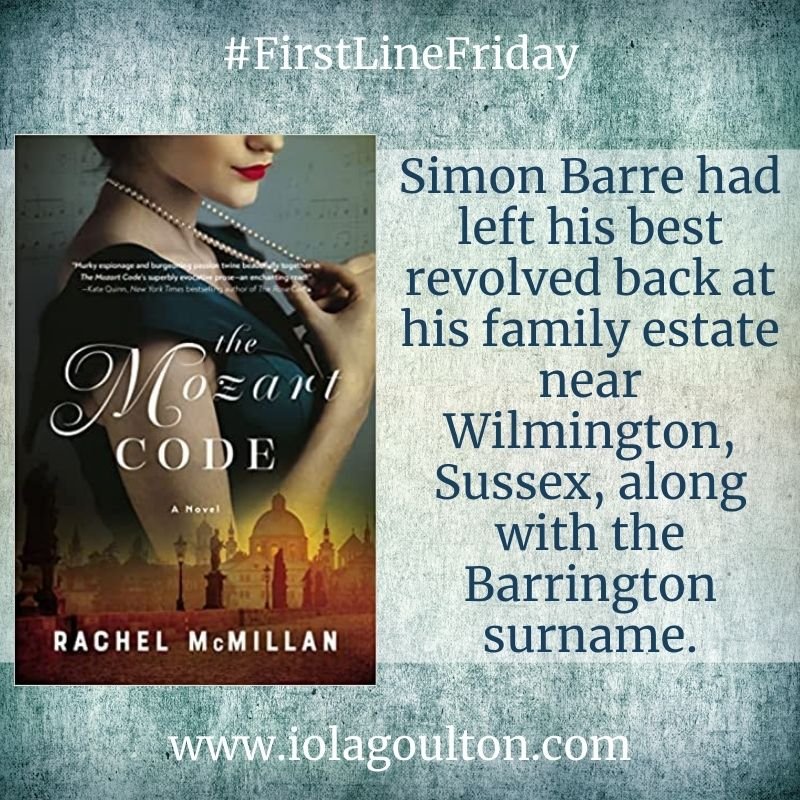
First Line Friday | Week #225 | The Mozart Code by Rachel McMillan

It’s First Line Friday! That means it’s time to pick up the nearest book and quote the first line. Today I’m sharing from The Mozart Code by Rachel McMillan, which is set in post-World War II Vienna, Austria.

Here’s the first line from the Chapter One:

Simon Barre had left his best revolved back at his family estate near Wilmington, Sussex, along with the Barrington surname.

What’s the book nearest you, and what’s the first line?

About The Mozart Code

No matter how you might try to hide in a war to escape your past, it is always close at hand.

Lady Sophia Huntington Villiers is no stranger to intrigue, as her work with Alan Turing’s Bombe Machines at Bletchley Park during the war attests. Now, as part of Simon Barre’s covert team in post-war Vienna, she uses her inimitable charm and code name Starling to infiltrate the world of relics: uncovering vital information that could tilt the stakes of the mounting Cold War. When several influential men charge her with finding the death mask of Mozart, Sophie wonders if there is more than the composer’s legacy at stake and finds herself drawn to potential answers in Prague.

Simon Barrington, the illegitimate heir of one of Sussex’s oldest estates, used the previous war to hide his insecurities about his past. Now, he uses his high breeding to gain access to all four allied quarters of the ruined city in an attempt to slow the fall of the Iron Curtain. He has been in love with Sophie Villiers since the moment he met her, and a marriage of convenience to save Simon’s estate has always kept her close. Until now, when Sophie’s mysterious client in Prague forces him to wonder if her allegiance to him—and their cause—is in question. Torn between his loyalty to his cause and his heart, Simon seeks answers about Sophie only to learn that everything he thought he knew about his involvement in both wars is based on a lie.

You can find The Mozart Code online at:

Amazon | BookBub | ChristianBook | Goodreads | Koorong
Click the button to check out what my fabulous fellow FirstLineFriday bloggers are sharing today:

You can then click the link which will take you to the master page of all this week’s #FirstLineFriday posts.

And you can click here to check out my previous FirstLineFriday posts.

Share your first line in the comments, and happy reading!

Don’t forget to click here to check out my Amazon shop for my top picks in Christian fiction!

Under a Sky of Memories

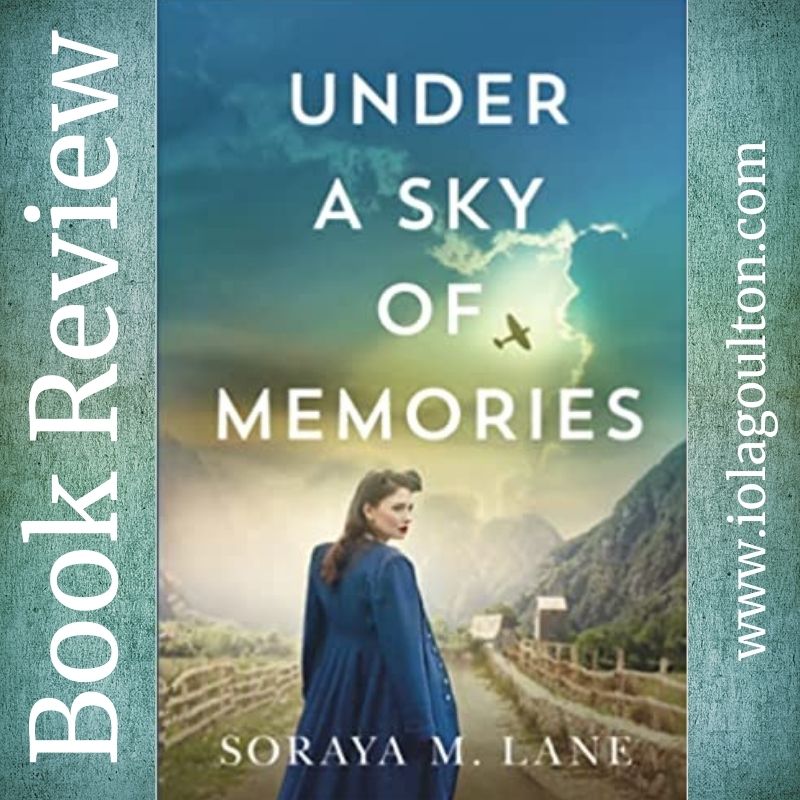
Book Review | Under a Sky of Memories by Soraya M Lane

Under a Sky of Memories is the story of Vita, Dot, and Evelyn, three American nurses who sign up to serve in World War II. As members of the Medical Air Evacuation Transport Squadron, they will be the nurses on board air ambulances, transporting injured soldiers away from the front lines so they can recover in proper hospitals.

They are posted to Catania in Sicily, where they find the work difficult but satisfying. Soon, they are all assigned to the same mission, a super flight with multiple doctors and nurses on board. A series of mishaps leads them to crash-land in Armenia … enemy territory.

The story then becomes a tale of survival: will the pilots, nurses, and medics survive?

Under a Sky of Memories is a gripping story with excellent characters. The writing is excellent, with plenty of suspense, made all the more engaging once I realised this was based on a true story. That’s actually an important fact, because otherwise it would be easy to complain the mistakes leading to the crash weren’t realistic!

The author has obviously done a heap of research, which is great, but it never overwhelms the story. Instead, the story very much focuses on the three nurses.

Recommended for historical fiction fans, especially those who enjoy World War II fiction.

Under a Sky of Memories isn’t Christian fiction but it doesn’t have any explicit sex or language, and I think it would appeal to fans of authors like Lynn Austin or Sarah Sundin.

Thanks to Lake Union Publishing and NetGalley for providing a free ebook for review.

About Soraya M Lane

Soraya M LaneSoraya M. Lane graduated with a law degree before realizing that law wasn’t the career for her and that her future was in writing. She is the author of historical and contemporary women’s fiction, and her novel Wives of War was an Amazon Charts bestseller.

Soraya lives on a small farm in her native New Zealand with her husband, their two young sons and a collection of four legged friends. When she’s not writing, she loves to be outside playing make-believe with her children or snuggled up inside reading.

Find Soraya Lane online at:

Website | Facebook | Instagram | Twitter

About Under a Sky of Memories

From the bestselling author of The Last Correspondent comes the powerful story of three brave women who go to war—and end up fighting for their lives.

Sicily, 1943. Three American women, all nurses in the Medical Air Evacuation Transport Squadron, are determined to do all they can for their country. Vita is fun-loving, Dot shy and sweet-natured, and Evelyn practical and determined, but for all their differences, a life of military service pulls the three together as firm friends.

When they’re selected for a daring mission, the women are proud to play their part. But disaster strikes when their plane crash-lands behind enemy lines in occupied Albania. Together with twenty-three other medics, they find themselves trapped, cut off from all communication with the squadron, and in terrifying and unimaginable danger.

As days and nights pass without hope of rescue, the group must travel on foot across unfamiliar terrain thick with Nazis and their violent local allies. Can Evelyn, Vita, and Dot survive the perilous journey through enemy territory—and finally find their way home?

Find Under a Sky of Memories online at:

Amazon | BookBub | Goodreads

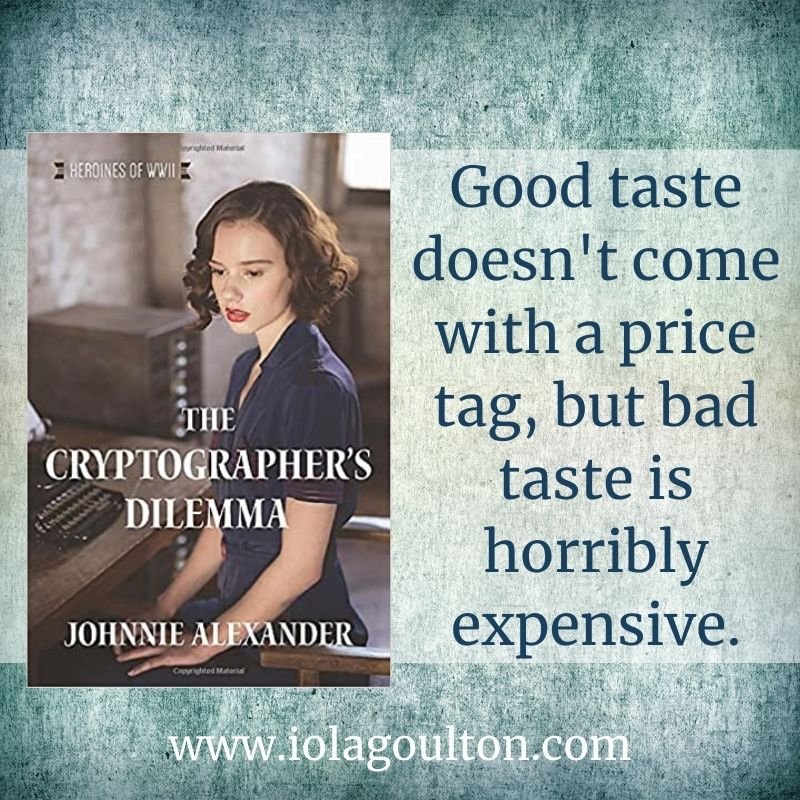
Good taste doesn't come with a price tag, but bad taste is horribly expensive.

Book Review | The Cryptographer’s Dilemma (Heroines of WWII) by Johnnie Alexander

Eloise Marshall was happy in her job as a maths teacher before the US Navy recruits her as a cryptographer … and she is then transferred to the FBI. After training, she is partnered with Phillip Clayton. He is unable to fight because he is colourblind … something I didn’t work out until about halfway through, despite the author’s effort to show it in the first line:

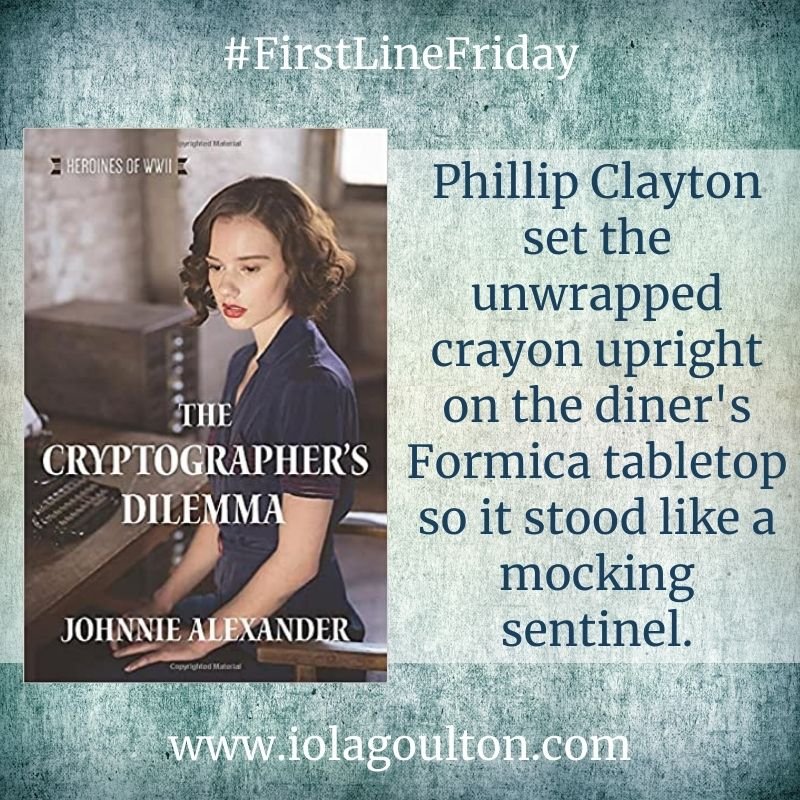
Phillip Clayton set the unwrapped crayon upright on the diner's Formica tabletop so it stood like a mocking sentinel.

(Was I the only person who didn’t understand he was colourblind?)

The FBI needs both Eloise’s code-breaking ability and a “womanly touch” to discover the truth behind some strange letters about broken dolls. Are the letters nothing more than they appear to be, or are they some kind of message within a message, a traitor using a steganography code to pass information to America’s enemies?

At one point, Phillip observes that Eloise doesn’t seem to notice masculine attention. He seems to see this as a positive, that she’s not trying to attract male attention. I saw it as a negative: how good is she as an FBI agent if she doesn’t notice the people around her?

I enjoyed the World War II setting.

I’m a big fan of novels featuring code-breaking and cryptography (e.g those by Roseanna M White). It was the cryptography that caught my attention. I also enjoyed the back-and-forth hunt for the evildoer—and I appreciated it even more when I read the Author’s Note at the end and discovered the plot was based on fact.

But I was kind of lost when it came to Eloise’s “dilemma”. What was it? I can only assume it was the will-she-won’t-she search for the father who abandoned her and her mother … a plot point I thought was weakened by the fact we didn’t know she was searching for him.

Nevertheless, I enjoyed the story, as it’s a unique angle that made for a solid romance.

Thanks to Barbour Fiction and NetGalley for providing a free ebook for review.

About Johnnie Alexander

Johnnie AlexanderJohnnie Alexander creates characters you want to meet and imagines stories you won’t forget in a variety of genres. An award-winning, best-selling novelist, she serves on the executive boards of Serious Writer, Inc. and the Mid-South Christian Writers Conference, co-hosts Writers Chat, and interviews other inspirational authors for Novelists Unwind. Johnnie lives in Oklahoma with Griff, her happy-go-lucky collie, and Rugby, her raccoon-treeing papillon.

Find Johnnie Alexander online:

Website | Facebook | Instagram | Pinterest | Twitter

About The Cryptographer’s Dilemma

Full of intrigue, adventure, and romance, this new series celebrates the unsung heroes—the heroines of WWII.

FBI cryptographer Eloise Marshall is grieving the death of her brother, who died during the attack on Pearl Harbor, when she is assigned to investigate a seemingly innocent letter about dolls. Agent Phillip Clayton is ready to enlist and head oversees when asked to work one more FBI job. A case of coded defense coordinates related to dolls should be easy, but not so when the Japanese Consulate gets involved, hearts get entangled, and Phillip goes missing. Can Eloise risk loving and losing again?

Find The Cryptographer’s Dilemma online at:

Amazon | ChristianBook | Goodreads | Koorong
And don’t forget to click here to check out my Amazon shop for my top picks in Christian fiction!

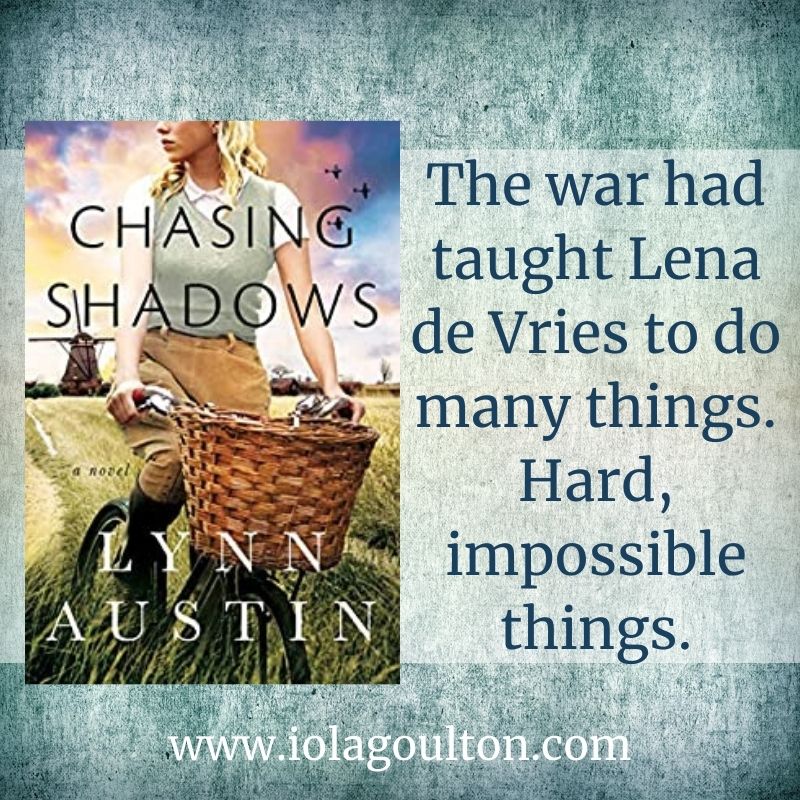
The war had taught Lena de Vries to do many things. Hard, impossible things.

Book Review | Chasing Shadows by Lynn Austin

It’s been a while since I read a Lynn Austin novel, and I’d forgotten what a brilliant writer she is. In Chasing Shadows, she takes on what I think is a new time period for her: World War II.

She also introduces a setting that I haven’t seen before in WWII Christian fiction: the Netherlands.

The story stars at the end of the war, as the Allies finally free the Netherlands from the tyranny of the Nazis. We are introduced to Lena, a farmer’s wife, and to her (mostly absent) family, and to the shadow people … the people she hides in her barn and cellar.

The novel then slips back in time by six years, to June 1939, shortly before the war started (yes, American readers: World War II started in September 1939).

There are three main characters in the novel: Lena, a farmer’s wife; Ans, her rebellious eighteen-year-old daughter; and Miriam, a Jewish musician from Germany. Chasing Shadows follows each of them through the war – escaping from Germany, the outbreak of war, the invasion of the neutral Netherlands. Each woman is faced with hard, almost impossible choices, choices which challenge and refine their faith. They have to choose to do the hard thing over and over because it’s the only right thing.

In many ways, Chasing Shadows was a difficult novel to read.

While Lena, Ans, and Marian are all fictional characters, history has already taught us that these things happened, and that normal women like these had to make impossible choices to survive themselves and protect those they loved. And while we know the end of the story (the Allies were victorious and the Netherlands was freed), we don’t know what is going to happen to the characters in the story. At times, that tension was almost unbearable.

Chasing Shadows is a brilliant World War II novel that shows how the Dutch people reacted to the Nazi occupation, the choices they made, and the trials they faced. It highlights the oustanding yet dangerous work of the Dutch Resistance movement.

Most of all, it shows how much of this work was done by everyday Christians working to protect the Jews and other enemies of the Nazis. As such, it is both encouraging and challenging as it shows Dutch Christians loving their neighbours—Jewish and otherwise—as the Bible commands.

Overall, Chasing Shadows by Lynn Austin is a powerful novel about the trials and triumphs faced by the Dutch in World War II, shown through the eyes of three very different women.

Chasing Shadows by @LynnNAustin is a powerful novel about the trials and triumphs faced by the Dutch in World War II. #BookReview #ChristianFiction Share on X

Recommended.

Thanks to Tyndale Publishing and NetGalley for providing a free ebook for review.

About Lynn Austin

Lynn AustinFor many years, Lynn Austin nurtured a desire to write but frequent travels and the demands of her growing family postponed her career. When her husband’s work took Lynn to Bogota, Colombia, for two years, she used the B.A. she’d earned at Southern Connecticut State University to become a teacher. After returning to the U.S., the Austins moved to Anderson, Indiana, Thunder Bay, Ontario, and later to Winnipeg, Manitoba.

It was during the long Canadian winters at home with her children that Lynn made progress on her dream to write, carving out a few hours of writing time each day while her children napped. Lynn credits her early experience of learning to write amid the chaos of family life for her ability to be a productive writer while making sure her family remains her top priority.

Along with reading, two of Lynn’s lifelong passions are history and archaeology. She and her son traveled to Israel during the summer of 1989 to take part in an archaeological dig at the ancient city of Timnah. Lynn resigned from teaching to write full-time in 1992. Since then she has published 24 novels.

Find Lynn Austin online at:

Website | Facebook | Pinterest | Twitter

About Chasing Shadows

For fans of bestselling WWII fiction comes a powerful novel from Lynn Austin about three women whose lives are instantly changed when the Nazis invade the neutral Netherlands, forcing each into a complicated dance of choice and consequence.

Lena is a wife and mother who farms alongside her husband in the tranquil countryside. Her faith has always been her compass, but can she remain steadfast when the questions grow increasingly complex and the answers could mean the difference between life and death?

Lena’s daughter Ans has recently moved to the bustling city of Leiden, filled with romantic notions of a new job and a young Dutch police officer. But when she is drawn into Resistance work, her idealism collides with the dangerous reality that comes with fighting the enemy.

Miriam is a young Jewish violinist who immigrated for the safety she thought Holland would offer. She finds love in her new country, but as her family settles in Leiden, the events that follow will test them in ways she could never have imagined.

The Nazi invasion propels these women onto paths that cross in unexpected, sometimes-heartbreaking ways. Yet the story that unfolds illuminates the surprising endurance of the human spirit and the power of faith and love to carry us through.

Find Chasing Shadows online at:

Amazon | BookBub | ChristianBook | Goodreads | Koorong

And don’t forget to click here to check out my Amazon shop for my top picks in Christian fiction!

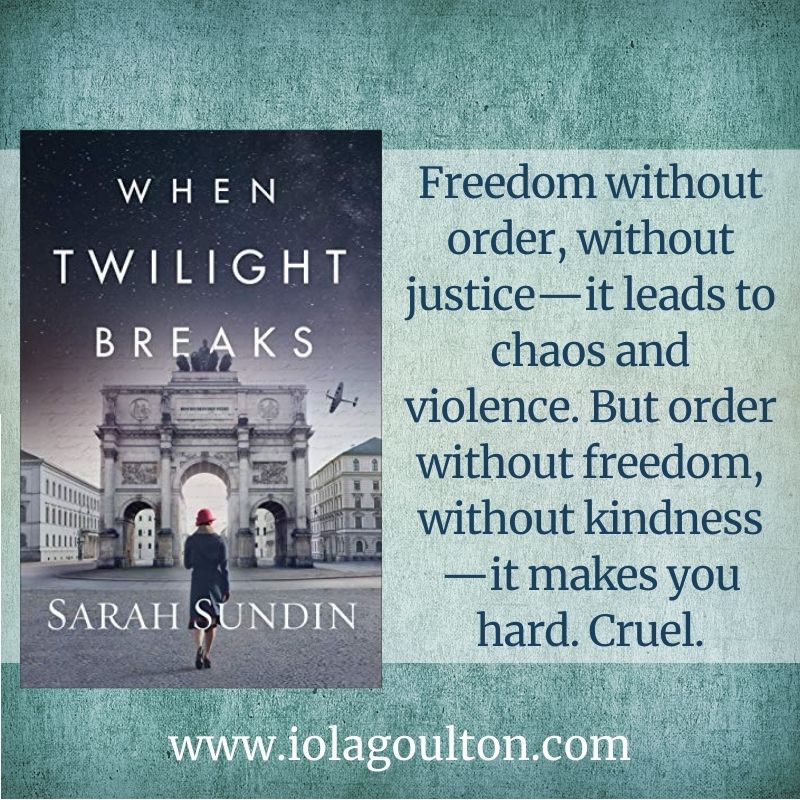
Freedom without order, without justice—it leads to chaos and violence. But order without freedom, without kindness—it makes you hard. Cruel.

Book Review | When Twilight Breaks by Sarah Sundin

When Twilight Breaks is set in 1938 Munich, Germany. Each chapter starts with the day and date, which gave the novel a sense of urgency, as though it was all leading up to some fateful day in history (but which day? I couldn’t remember, and that helped with the suspense).

Evelyn Brand is an American journalist working in Germany as a foreign correspondent.

That was two pluses in her favour: she was a professional woman, and her profession was why she was in Hitler’s Germany.

(This is important, as many years ago I read another novel about an American novel in Hitler’s Germany which made no sense, because the character had no compelling reason to be there. The result was I didn’t much care whether she succeeded in escaping or not).

Evelyn sees the dark underbelly of fascism and wants to report that to her American readers. However, that leaves her having to find the narrow line between telling the truth and not telling so much of the truth that the Germans will find out and expel her from the country … or worse.

Unfortunately, as the sole female in her news office, she’s often given the ‘softball’ assignments. One of these introduces her to Peter Lang, an American professor at the nearby university who is pursuing his PhD.

Peter admires what Hitler has done for the German people. He reduced unemployment and brought prosperity back to a country suffering from the losses of World War I and the subsequent global depression. He wishes America were the same.

In hindsight, we all know Hitler’s Germany was evil.

The Nazi regime killed undesirables—the ‘work shy’, the disabled, the Jews, anyone who spoke out against the government. So it’s interesting to see Peter’s early perspective, and see how he has been deceived by outward appearance. At the same time, he’s obviously the hero, which means he has to change his mind …

Peter was not alone in his views. I heard a podcast interview with Sarah Sundin where she commented that those Americans who travelled to Germany in the 1930s expecting to find a successful society found one, and those who expected to find a facade with a sordid underbelly found that. It shows the importance of looking at both sides of an issue, and how politics is often more grey than black and white.

Free speech is an issue Evelyn and Peter debate:

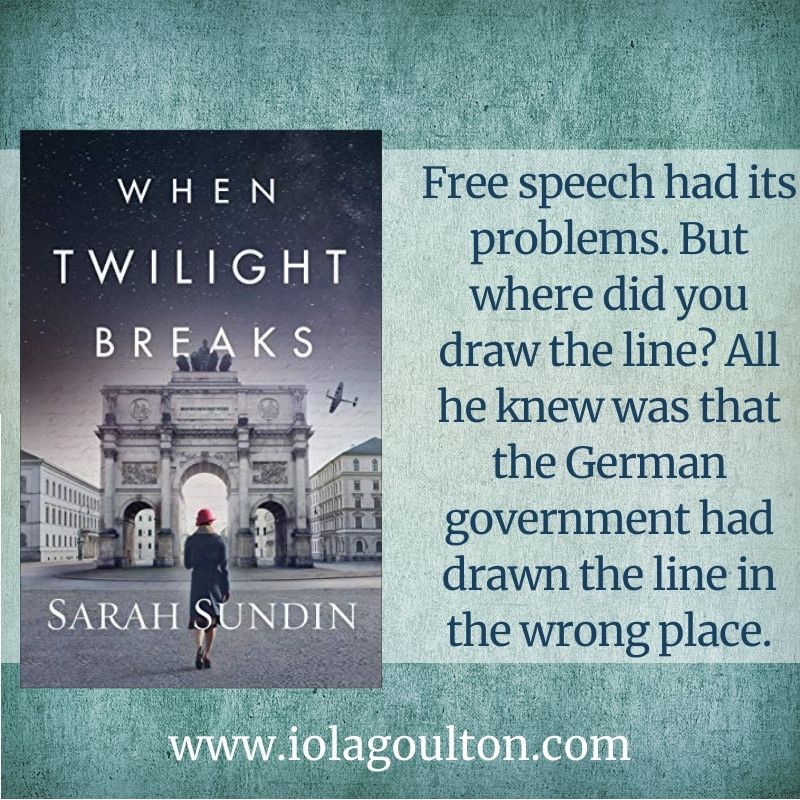
“Free speech had its problems. Free speech could work people into a frenzy, leading to violence. But where did you draw the line? All he knew was that the Germany government had drawn the line in the wrong place.”

This highlights a current issue: where do we draw the line? What is the difference between free speech and hate speech? Do we allow hate speech as part of our effort to protect free speech? And what happens when hateful speech leads to hateful action and people die?

Yes, When Twilight Breaks asks big questions, questions that don’t have easy answers. That made for a fascinating read.

However, I did find he last quarter slow going. I don’t want to give spoilers, but it felt like the story petered (sorry!) out at around the 75% mark. An earlier minor conflict was reintroduced, and it felt like it was added and magnified in an attempt to drag the story out. The last quarter wasn’t bad. It just didn’t match the strength and pace of the first three-quarters of the novel.

When Twilight Breaks by @SarahSundin is both an excellent Christian historical romance, and a thought-provoking metaphor for our modern world. #ChristianFiction Share on X

But I still recommend When Twilight Breaks, both as an excellent Christian historical romance, and as a thought-provoking metaphor for our modern world. May we learn from the lessons of the past and not repeat them.

Thanks to Revell and NetGalley for providing a free ebook for review.

About Sarah Sundin

Sarah SundinSarah Sundin is the author of The Sea Before Us and The Sky Above Us, as well as the Waves of Freedom, Wings of the Nightingale, and Wings of Glory series. Her novels have received starred reviews from BooklistLibrary Journal, and Publishers Weekly. Her popular Through Waters Deep was a Carol Award finalist, and both Through Waters Deep and When Tides Turn were named on Booklist‘s “101 Best Romance Novels of the Last 10 Years.” Sarah lives in Northern California.
Find Sarah Sundin online at:

Website | Facebook | Instagram | Pinterest | Twitter

About When Twilight Breaks

Munich, 1938. Evelyn Brand is an American foreign correspondent as determined to prove her worth in a male-dominated profession as she is to expose the growing tyranny in Nazi Germany. To do so, she must walk a thin line. If she offends the government, she could be expelled from the country–or worse. If she fails to truthfully report on major stories, she’ll never be able to give a voice to the oppressed–and wake up the folks back home.

In another part of the city, American graduate student Peter Lang is working on his PhD in German. Disillusioned with the chaos in the world due to the Great Depression, he is impressed with the prosperity and order of German society. But when the brutality of the regime hits close, he discovers a far better way to use his contacts within the Nazi party–to feed information to the shrewd reporter he can’t get off his mind.

This electric standalone novel from fan-favorite Sarah Sundin puts you right at the intersection of pulse-pounding suspense and heart-stopping romance.

Find When Twilight Breaks online at:

Amazon | BookBub | ChristianBook | Goodreads | Koorong

And don’t forget to click here to check out my Amazon shop for my top picks in Christian fiction!

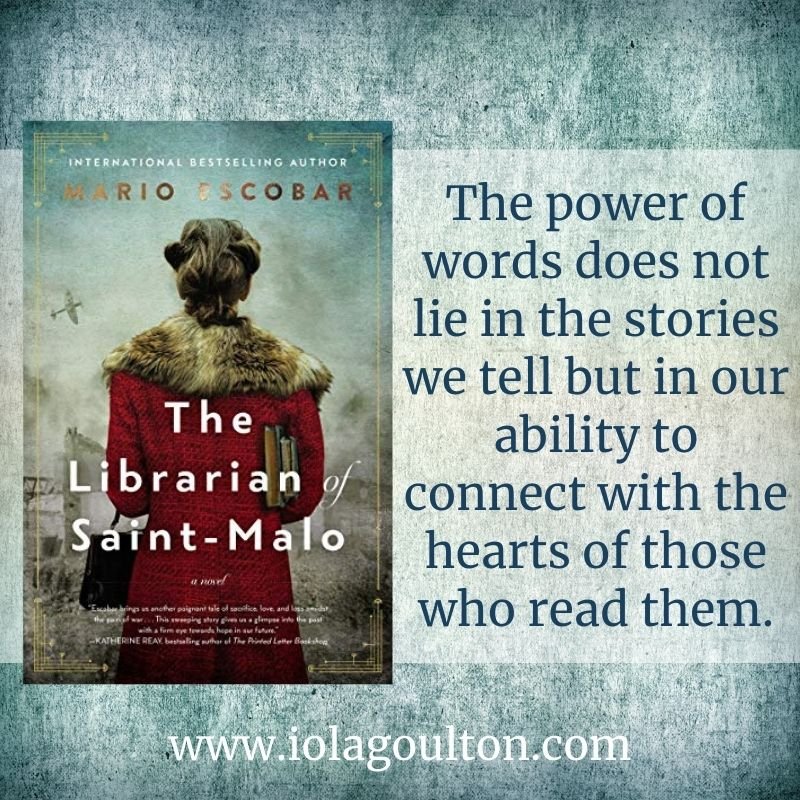
The power of words does not lie in the stories we tell but in our ability to connect with the hearts of those who read them.

Book Review | The Librarian of Saint-Malo by Mario Escabar

The Librarian of Saint-Malo features, unsurprisingly, the town librarian from the small French town of Saint-Malo as a main character. Jocelyn and Antoine Ferrec marry on 1 September 1939, the day Germany illegally invades Poland, the event which creates World War II.

History tells us the city and the country did not fare well in the war.

This novel shows us some of what happened from a French point of view. That was a new perspective for me. While I’ve read a lot of novels set in and around World War II, almost all of them have been set in the USA or England, and told from the American or English point of view–American or English authors, and American or English characters.

A smaller number have shown the war in Germany, but still from the American or English viewpoint. Where there have been German characters, they’ve either been “good” Nazis (which are about as believable as “good” slaveowners in American Civil War fiction) or the Nazis have been the evildoers (well, history).

It was refreshing to read a story showing the war from the point of view of the occupied French.

(The book is written by a Spaniard, who were neutral in World War II). It provided new insights into the occupation, and didn’t have the American need for a stereotypical heroic main character. It’s a welcome difference.

I’ve seen a couple of reviews moaning about this book as being yet another Nazi romance, with the subtext being that the Nazis were monsters and we shouldn’t be trying to romanticise them. While I agree we shouldn’t romanticise evil, I don’t think this book can truthfully be classed with other Nazi romances.

First, The Librarian of Saint-Malo is not a romance (it’s historical fiction).

Second, while one of the German soldiers clearly has feelings for Jocelyn, I didn’t think she was anywhere close to being in love with him. And finally, the story wasn’t written by a white American woman trying to show a redemption story. It was more a gritty war story written by a Spanish man. As such, the ending is more inevitable than the happy-ever-after of a romance novel.

The novel is introduced as a series of letters from Jocelyn, the Saint-Malo librarian, to her literary hero, the fictional Marcel Zola. She explains in the Prologue why she has chosen to write to him, and there is the occasional mention of the letters or reminder in the body of the novel that these are meant to be letters. But they’re not—not like in other epistolary novels, like Daddy Long Legs by Jean Webster, Dear Mr. Knightley by Katherine Reay, Things We Didn’t Say by Amy Lynn Green, or The Guernsey Literary and Potato Peel By Society by Mary Ann Safer and Annie Barrows.

The Librarian of Saint-Malo by Mario Escabar is a unique epistolary novel about World War II, set in France and written by a Spaniard. #HistoricalFiction #BookReview Share on X

Instead, the story read much like any other historical novel, albeit one written in first person point of view, as a letter would be. The story was exceptionally well researched (well, except for the line about “God Save the Queen”. The song changes names depending on who is on the throne, and the monarch during World War II was King George). I especially liked the fact the novel was written by a Spaniard—we need more historical fiction written from non-American perspectives.

We see the war progress through Jocelyn’s eyes.

We see the fall of France, the refugees (that was new to me), the arrival of the Germans, billetting, and the SS. The story takes us through the emotion of a lot of these events in a way a history book can’t, but the overall voice is still one of a person telling her story and trying to keep the emotion out of it. The French might mock the British for their stiff upper lips, but Jocelyn does a good impression. But the understated emotion makes it all the more powerful.

This is the first translated Mario Escabar novel I’ve read. I was impressed, and I will certainly watch out for future novels from him. Recommended for historical fiction fans.

Thanks to Thomas Nelson and NetGalley for providing a free ebook for review.

About The Librarian of Saint-Malo

Through letters with a famous author, one French librarian tells her love story and describes the brutal Nazi occupation of her small coastal village.

Saint-Malo, France: August 1939. Jocelyn and Antoine are childhood sweethearts, but just after they marry, Antoine is called up to fight against Germany. As the war rages, Jocelyn focuses on comforting and encouraging the local population by recommending books from her beloved library in Saint-Malo. She herself finds hope in her letters to a famous author.

After the French capitulation, the Nazis occupy the town and turn it into a fortress to control the north of French Brittany. Residents try passive resistance, but the German commander ruthlessly purges part of the city’s libraries to destroy any potentially subversive writings. At great risk to herself, Jocelyn manages to hide some of the books while waiting to receive news from Antoine, who has been taken to a German prison camp.

What unfolds in her letters is Jocelyn’s description of her mission: to protect the people of Saint-Malo and the books they hold so dear. With prose both sweeping and romantic, Mario Escobar brings to life the occupied city and re-creates the history of those who sacrificed all to care for the people they loved.

You can find The Librarian of Saint-Malo online at:

Amazon | BookBub | ChristianBook | Goodreads | Koorong

If you really love your country there's no need to surround yourself with its symbols or brag about your origins.

God has chosen this story for us, and not another one, and I mean to live this story as best I can with the time I'm given.

Book Review | Things We Didn’t Say by Amy Lynn Green

Things We Didn’t Say is an unusual novel with an unusual heroine.

Johanna Berglund, the main character, speaks seven languages (and is trying to learn Japanese) when she is “persuaded” to return to her hometown of Ironside Lake to serve as a translator for the Germans in the new prisoner of war camp.

Johanna finds herself accused of treason, and the novel is the collection of documents she prepares for her lawyer to prove her innocence—letters to, from, and about her, and a collection of newspaper articles, editorials, and letters to the editor. The letters show Johanna’s virtues and faults in her own eyes, and through the eyes of friends, family, and foe.

I think this country needs a voice willing to speak up and question blind patriotism, and that's what you're doing.

The best historical fiction uses historical events and characters to highlight issues in the present.

Things We Didn’t Say does a masterful job of examining racism and our often irrational feelings towards those who are different to us—whether they look like us or not. It’s also telling that Green has chosen to set her story in a small town that’s home to Americans of Scandinavian descent—people who sometimes look more Aryan than their German enemies, yet people who also discriminate against Japanese Americans and African Americans.

What often has the most impact isn’t the obvious themes of the story, but the offhand comments—like the US Constitution’s definition of treason, or the kitchen hand who owns a copy of “The Negro Motorist Green Book, with safe hotels, filing stations, and eateries marked.” I’ve read my share of travel guides, but they have all aimed to sort the good from the less-good, not the safe from the unsafe.

The unusual structure gives the novel a more slow-paced feel than a “normal” novel might have. It’s also easier to stop reading than in a novel written in more traditional chapters with the cliffhanger or hook at the end of each chapter. Letters have a different structure, and mean it is a little easier to put the novel down. But it’s also easy to pick up again, and to only read one or two letters at a time. If anything, reading slowly is more representative of the timescale covered in the novel.

Every letter has two messages: the one written on the lines and the one written between them. Both are necessary.

The title is also apt, in that a lot of the story is hidden in the things the characters don’t say in writing—another reason to read it slowly. The Things We Didn’t Say is an excellent if unusual novel.

Recommended for historical fiction fans or those interested in a Christian novel written in a non-traditional style.

Thanks to Bethany House and NetGalley for providing a free ebook for review.

About Amy Lynn Green

Find Amy Lynn Green online at:

Website | Facebook | Instagram

About Things We Didn’t Say

Headstrong Johanna Berglund, a linguistics student at the University of Minnesota, has very definite plans for her future . . . plans that do not include returning to her hometown and the secrets and heartaches she left behind there. But the US Army wants her to work as a translator at a nearby camp for German POWs.

Johanna arrives to find the once-sleepy town exploding with hostility. Most patriotic citizens want nothing to do with German soldiers laboring in their fields, and they’re not afraid to criticize those who work at the camp as well. When Johanna describes the trouble to her friend Peter Ito, a language instructor at a school for military intelligence officers, he encourages her to give the town that rejected her a second chance.

As Johanna interacts with the men of the camp and censors their letters home, she begins to see the prisoners in a more sympathetic light. But advocating for better treatment makes her enemies in the community, especially when charismatic German spokesman Stefan Werner begins to show interest in Johanna and her work. The longer Johanna wages her home-front battle, the more the lines between compassion and treason become blurred–and it’s no longer clear whom she can trust.

You can find Things We Didn’t Say online at

Amazon | ChristianBook | Goodreads | Koorong

First Line Friday

First Line Friday | Week 155 | Things We Didn’t Say by Amy Lynn Green

It’s First Line Friday! That means it’s time to pick up the nearest book and quote the first line. Today I’m sharing from Things We Didn’t Say, a unique debut from by Amy Lynn Green. Here’s the first line from the Prologue:

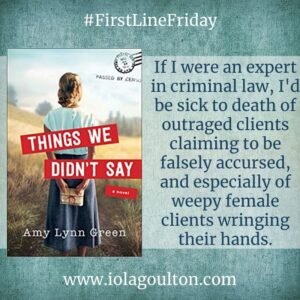
If I were an expert in criminal law, I'd be sick to death of outraged clients claiming to be falsely accursed, and especially of weepy female clients wringing their hands.

What’s the book nearest you, and what’s the first line?


About Things We Didn’t Say

Headstrong Johanna Berglund, a linguistics student at the University of Minnesota, has very definite plans for her future . . . plans that do not include returning to her hometown and the secrets and heartaches she left behind there. But the US Army wants her to work as a translator at a nearby camp for German POWs.

Johanna arrives to find the once-sleepy town exploding with hostility. Most patriotic citizens want nothing to do with German soldiers laboring in their fields, and they’re not afraid to criticize those who work at the camp as well. When Johanna describes the trouble to her friend Peter Ito, a language instructor at a school for military intelligence officers, he encourages her to give the town that rejected her a second chance.

As Johanna interacts with the men of the camp and censors their letters home, she begins to see the prisoners in a more sympathetic light. But advocating for better treatment makes her enemies in the community, especially when charismatic German spokesman Stefan Werner begins to show interest in Johanna and her work. The longer Johanna wages her home-front battle, the more the lines between compassion and treason become blurred–and it’s no longer clear whom she can trust.

You can find Things We Didn’t Say online at

Amazon | ChristianBook | Goodreads | Koorong

Click the button to check out what my fabulous fellow FirstLineFriday bloggers are sharing today:

You can then click the link which will take you to the master page of all this week’s #FirstLineFriday posts.

And you can click here to check out my previous FirstLineFriday posts.

Share your first line in the comments, and happy reading!

And don’t forget to click here to check out my Amazon shop for my top picks in Christian fiction!