Category: Bookish Question

Do you read book endorsements? Do they influence your book buying decisions?

Bookish Question #147 | Do you read book endorsements?

No, I don’t read book endorsements, and they don’t influence my book buying decisions.

There is a reason for this. I had a bad experience a few years back when I bought a book based on the endorsement of an author I enjoyed reading. I can’t remember the book or the author (either of them). All I know is that I didn’t enjoy the book, and I was left feeling that the author endorsing the novel had misled me.

Then it happened again, with a different book and different authors.

I learned that some authors are expected to endorse other authors with the same publisher, which lessened the impact of all endorsements in my eyes. I later learned that some authors don’t even read the books they’re asked to endorse, which makes the endorsement the sad waste of a tree.

Fake endorsements are like fake reviews.

If you can’t tell which reviews are genuine and which are fake, you’re going to be wary of all reviews.

I’ve had a similar experience with those authors who advertise books in their newsletters. To me, advertising a book in a newsletter constitutes an endorsement. At first, I thought the authors were recommending books they’d read and enjoyed (and, to be fair, most are). But some are engaging in newsletter swaps to build their email list, and that means featuring books they haven’t read. It seems to me that advertising or endorsing a book you haven’t read could hurt your brand if your readers decide the books you’re endorsing aren’t up to standard.
And that’s why I started ignoring book endorsements.

What about you? Do you read book endorsements, and do they influence your book buying decisions?

What about you? How often do you like to receive author newsletters?

Bookish Question #146 | How often do you like to receive author newsletters?

It depends.

There are some newsletters I’ve unsubscribed from because they emailed too often—generally once a week (sometimes more). The problem wasn’t so much the frequency as the fact that the email didn’t have any content I found useful. Often, it was little more than links to books by other authors in the same genre, and the author said s/he hadn’t read the books. Why would someone advertise or endorse a book they hadn’t read? It seems like a recipe for disaster.

I don’t mind more frequent emails when there is something to say e.g. a book is available on preorder, or there a book is on sale. I especially don’t want to miss out on sale books, and a lot of sales only last a few days. Readers might miss out of the author waited for their regular monthly or even weekly newsletter.

But in general, less is more.

I’m happy to receive a newsletter once a month, or more often if there is a good reason. Otherwise, I’m likely to either unsubscribe or (worse) delete without reading.

What about you? How often do you like to receive author newsletters?

Do you follow your favourite authors on social media?

Bookish Question #144 | Do you follow authors on social media?

Yes, I do follow my favourite authors on social media. Which social media networks? It depends.

Twitter

I follow over 10,000 accounts on Twitter, and most of them are author accounts. Therefore, I’m pretty sure I follow most of my favourite authors on Twitter. But I don’t see all their posts. Twitter, like all social media platforms, has an algorithm that shows each user the posts Twitter thinks we are mostly likely to like or engage with.

I rarely see posts from my favourite authors on Twitter, but I’m not sure if that’s because they’re not active Twitter users, or because they mostly use Twitter for self-promotion.

Facebook

I follow a lot of author pages on Facebook, but I rarely see posts from them. Instead, the algorithm shows me pictures from friends and posts from the groups I’m active in. I’m also a member of a lot of groups I’m not active in, and I rarely see posts from those groups.

I am part of a few street team groups on Facebook, and I usually see (and respond to) those posts. I’m not sure if Facebook shows me those posts because I do tend to respond, or because I’ve asked to always see notifications from those groups.

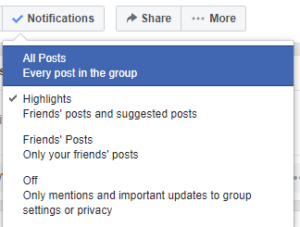
Facebook Tip

Authors, ask your group members to go to their notification settings and select “All posts” to increase your chances of showing up on their newsfeed.

Instagram

This is my favourite social network for following authors. It’s visual, which means it’s quick and easy to move through the feed, especially on a phone (I always check Instagram from my phone rather than my computer).

Oddly enough, Instagram is one social network where I don’t mind a little self-promotion.

I think this is because Instagram is visual, so people tend to post pictures of their book or quotes from their book rather than a more obvious “buy my book!” and link. This lack of spam could also be because Instagram only permits one link (in your bio), and doesn’t have any live links in posts.

Pinterest

Of the big four social networks, Pinterest is the one I use least often. When I do go on Pinterest, I’m usually looking for recipes rather than books. I do follow a bunch of authors on Pinterest, but the algorithm tends to show me pictures of food or clothes, not necessarily posts from the people I follow.

So I follow authors on all the main social networks, but Instagram is my favourite.

What about you? Do you follow your favourite authors on social media? If so, which social media networks do you use?

Do you read an excerpt or first chapter sample before buying a book?

Bookish Question #143 | Do you read an excerpt or first chapter sample before buying a book?

Sometimes.

(Well, I had to say something other than my usual “It depends”!)

There are times when I don’t read a sample before downloading (or buying) the book:

  • When the book is a review copy, because I’m not “buying” it, and there is no sample available (as review copies are usually pre-release books).
  • When the book is free on Kindle, because books are often only free for a short period, and I wouldn’t want to download the sample, not read it, then miss out on the free book because of my own tardiness.
  • I may also click Buy without reading the sample on a book that’s on a short-term 99 cent sale so I don’t miss out. This is especially the case if I’ve read and enjoyed other books by that author, or if I’ve seen the book recommended by someone I trust.
  • When the book is a preorder. Kindle samples are only available for books that are for sale, but many authors offer 99 cent or $2.99 preorder specials. If it’s an author I’ve read and enjoyed before, then it’s easy to click Buy on a 99 cent preorder.

If the book is more expensive, then my decision will depend on the price, the book, and the author—I’m more likely to click Buy on a book I’ve been waiting for (e.g. because it’s the next in a series I enjoy) than on an unknown book from a less familiar author.

Otherwise, I’ll download and read the Kindle sample.

Why? Because I already have hundreds of unread books (fiction and nonfiction) on my Kindle. I don’t want to spend money on more books unless I’m confident I’m going to read and enjoy it. The books I abandon are generally those where I didn’t read a sample first. If I read and enjoyed the sample, then I’m likely to want to read the whole book.

What about you? Do you read an excerpt or first chapter sample before buying a book?

Bookish Question #142 | Which authors or novels to you think best illustrate healthy Christian family relationships?

This is another excellent question.

Fiction is about conflict, and that conflict is often in the context of a family relationship. It may be a stage-of-life thing, but I’m over books where the teenage protagonist has #FirstWorldProblems with their (in my opinion) reasonable parent or parents. I’m also not keen on books where the parents are made out to be some kind of ogres … who have magically produced a well-adjusted child or teenager. #YeahRight.

But there is more to family relationships than parents and children.

There is also siblings … and there are a lot of stories which feature siblings.

Susan May Warren’s Christiansen Family series features the Christiansen siblings (and their parents). Now, it has to be said that they aren’t always “healthy” family relationships, but the emphasis is on acknowledging problems and doing whatever you can to fix the relationships. That’s healthy.

Dee Henderson’s O’Malley romantic suspense series features seven adopted siblings, so that’s a different kind of family. They also disagree, but they’re all noble adults who would do anything for each other.

And, of course, there are Clarke and Marty’s family from Love Comes Softly by Janette Oke, and the Baxter family by Karen Kingsbury, as I mentioned last week.

It’s interesting that all the examples I can think of are series.

Can you think of any standalone novels that do a great job of showing healthy Christian family relationships? Or any series I’ve missed?

The biggest subgenre in Christian fiction is romance, and the definition of a romance novel is that it ends with the promise of a happy-ever-after. It doesn't then go on to show that happy-ever-after. Some women's fiction novels do deal with marriage, but the focus is more likely to be a marriage in trouble. As such, it shows the main character (usually the wife) and their marriage partner overcoming their issues. Although, if I think about it, isn't that the definition of a healthy relationship: one where the people involved work together to overcome their issues? There is also the problem of the nature of fiction: it's about conflict. As such, a healthy Christian marriage is never going to be the focus of a Christian novel (although it could be the backdrop). After all, fiction loves contrast, and what better contrast to relationship drama than a healthy Christian marriage? There are several Christian authors who do this well, including Catherine West and Elizabeth Musser. Having said that, I do think their are some authors and series who do a great job of depicting healthy Christian marriage. The classic is Janette Oke, with both the Love Comes Softly and the Canadian West series (serieses?). Another example is Karen Kingsbury with the everlasting novels about the ever-growing Baxter family. Neither series depict perfect marriages (although the Baxter novels come melodramatically close), but that's good: there is no perfect marriage. And perhaps that's something our romance novels should make clear. But that's a topic for another day. What about you? What authors or novels do you think best illustrate a healthy Christian marriage? Why?

Bookish Question #141 | Which authors or novels do you think best illustrate a healthy Christian marriage?

The biggest subgenre in Christian fiction is romance, and the definition of a romance novel is that it ends with the promise of a happy-ever-after. It doesn’t then go on to show that happy-ever-after.

Some women’s fiction novels deal with marriage.

But the focus in women’s fiction is more likely to be a marriage in trouble. As such, it shows the main character (usually the wife) and their marriage partner overcoming their issues. Although, if I think about it, isn’t that the definition of a healthy relationship: one where the people involved work together to overcome their issues?

There is also the problem of the nature of fiction: it’s about conflict.

As such, a healthy Christian marriage is never going to be the focus of a Christian novel (although it could be the backdrop). After all, fiction loves contrast, and what better contrast to relationship drama than a healthy Christian marriage? There are several Christian authors who do this well, including Catherine West and Elizabeth Musser.

Having said that, I do think their are some authors and series who do a great job of depicting healthy Christian marriage. The classic is Janette Oke, with both the Love Comes Softly and the Canadian West series (serieses?). Another example is Karen Kingsbury with the everlasting novels about the ever-growing Baxter family.

Neither series depict perfect marriages (although the Baxter novels come melodramatically close), but that’s good: there is no perfect marriage. And perhaps that’s something our romance novels should make clear. But that’s a topic for another day.

What about you? What authors or novels do you think best illustrate a healthy Christian marriage? Why?

Which authors or novels do you think best show realistic and inspiring Christian romantic relationships?

Bookish Question #140 | Which authors or novels do you think best show realistic and inspiring Christian romantic relationships? Why?

Interesting question! I know the old saying is that the course of true love never does run smooth, and that’s certainly the case for most romantic relationships in fiction. After all, conflict is an essential element of fiction, so where would our fiction be if there was no conflict?

But just because conflict is the norm in fiction doesn’t make it the norm in Christian romance relationships … well, I hope it doesn’t. Because while it might be realistic, it’s not inspiring.

So which authors or novels do show realistic and inspiring Christian romance relationships?

Well, first we have to ignore pretty much the entire romantic suspense genre—that’s all blood and murder, which should stay in fiction, thank you very much.

We can safely ignore mysteries (too many dead bodies), thrillers (also too many dead bodies), and speculative fiction (dragons and aliens?).

We can also ignore most historical fiction (even the romance), because good historical fiction is based on historical fact, and the facts weren’t always kind to women or minorities.

Realistic AND inspiring, remember?

That leaves us with some contemporary romance and women’s fiction, because women’s fiction often shows romantic relationships, even if they’re not the main point of the plot. So here are my picks:

  • Rose Dee
  • Varina Denman
  • Denise Hunter
  • Toni Shiloh
  • Courtney Walsh

What do you think? Which authors or novels best show realistic and inspiring Christian romantic relationships? Why?

Which is more important in an audiobook—the story, the author, or the narrator?

Bookish Question #139 | Which is more important in an audiobook—the story, the author, or the narrator?

The narrator.

As I said last week, I’m not a big audiobook listener. But when I have listened to audiobooks, the thing that’s make-or-break for me is the narrator.

Why?

Because a bad or boring narrator can ruin a good story.

Sure, I’ll pick out a book to listen to based on the author and the book description—the story. But what makes the story worth listening to—or not—is the quality of the narrator. A great narrator can make an average story sound exciting. A less-good narrator can send me to sleep with even the most exciting scene (and that’s A Bad Thing, given I tend to listen to audiobooks while I’m driving).

The most important thing I listen for in an audiobook is the narrator’s accent and tone.

My very British grandmother would only listen to audiobooks with British narrators. I’m not so fussy, but I do like the accent to match the characters and setting. Books set in England and featuring British characters should probably have a British narrator—unless the main character in the book is American.

Even more important is tone.

The best narrators can play multiple characters—male or female, British or American. They can give each point of view character a distinctive voice, so listening to the audiobook is more like listening to a radio play.

But I’ve started audiobooks where the narrator spoke in a monotone, to the point I couldn’t tell the difference between the point of view characters, or even between the male and female characters. There was such a complete lack of expression, even when the point of view character thought they’d come upon a mass murder scene, that I thought I was listening to a computer read. I wasn’t—I checked.

So if I was going to start listening to audiobooks, I’d make sure I checked the audio sample first. Because the narrator is definitely the most important thing to me.

What about you? Which do you think is more important in an audiobook—the story, the author, or the narrator?

Do you listen to audiobooks? Why or why not?

Bookish Question #138 | Do you listen to audiobooks? Why or why not?

I’m not a big audiobook listener, for two reasons:

1. I’m a fast reader, so find it’s quicker to read than to listen.

If I’m enjoying a story, I want to get on with it … which means reading faster and faster, not waiting for the audio to catch up with my thoughts. Yes, I know audiobooks (well, some audiobooks) can be played at 1.5 times or 2 times speed, but then they can end up sounding like Alvin and the Chipmunks …

2. I don’t spend a lot of time in my car or doing tasks that would make listening an option.

Where I do have car time, I tend to listen to podcasts—they’re shorter, and it doesn’t matter if you miss a couple of details (the really important content, like the links, will be in the show notes). With a novel, it’s important to be able to see/hear and retain all the details because missing an important detail might affect your overall enjoyment or appreciation of the book.

Also, audiobooks are long—usually eight to ten hours, and sometimes longer.

I can see the appeal of audiobooks for someone who has an hour or more a day of otherwise dead time e.g., driving or waiting for children, or even exercising (assuming they’re going for a quiet walk, not taking a class or exercising in a gym pumping loud music out of the speakers).

If you’ve got a good chunk of time each day and can get through an audiobook in a week or two, then I can see them as a great way to pep up otherwise useless driving or waiting time. But they are less good for someone like me who would only be listening in ten or fifteen-minute slots two or three times a week. It would take forever to get into the story, and would be too easy to forget the details between sessions.

But that’s me. What about you? Do you listen to audiobooks? Why, or why not?