Tag: Christian Nonfiction

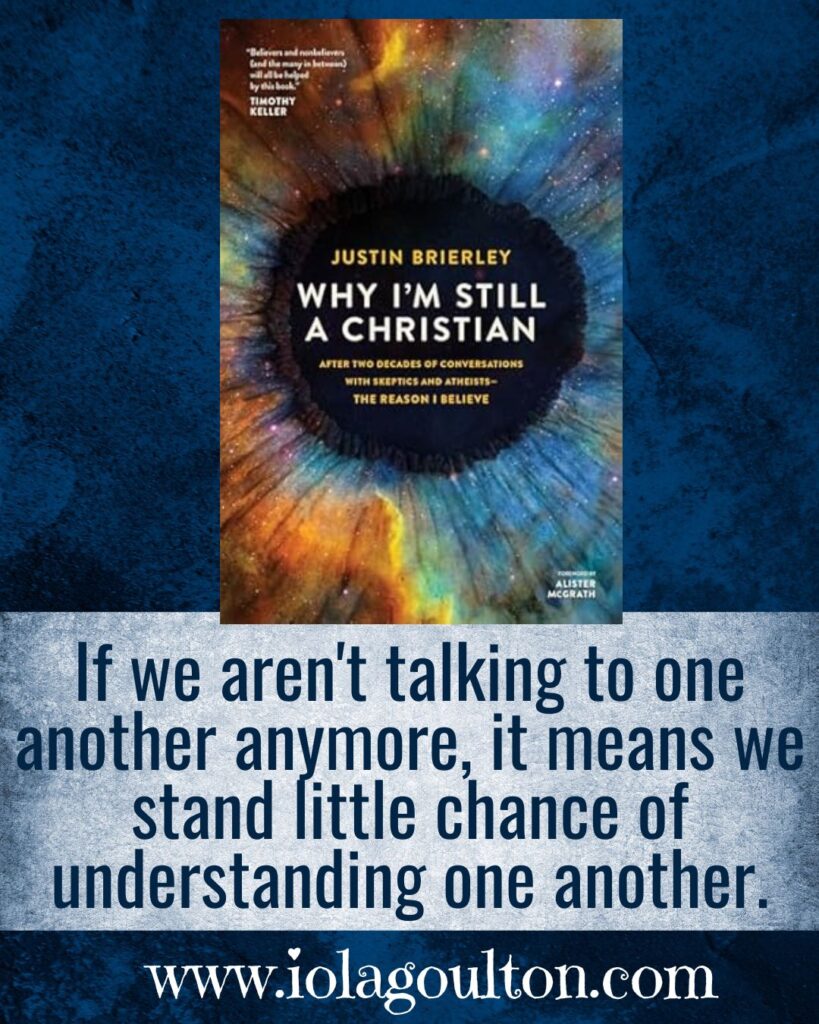
If we aren't talking to one another anymore, it means we stand little chance of understanding one another.

Book Review | Why I’m Still a Christian by Justin Brierley

I’m always intrigued to know how people (especially adults) decide to become a Christian. I’m equally intrigued to understand why Christians, in this age of doubt and deconstruction, maintain their belief in Jesus. I’m intrigued, but many of the arguments for and against faith are built on false logic. (“Christians still sin, so God can’t be real” – which is the doctrinal equivalent of throwing the baby out with the bathwater). Others are expressed in academic terms I find difficult to relate to.

Why I’m Still a Christian is built on over fifteen years of dialogue with Christians and atheists of all persuasions on his weekly radio show-turned podcast, Unbelievable. Brierley is also widely read, in that he quotes from books by mainstream Christin apologists such as C. S. Lewis and Lee Stobel, but also from nonChristian and atheist authors, who often make the case for Jesus even more powerfully than Brierley can.

This is the strength of the book.

While it is Brierley’s personal testimony and rationale for Christianity, it’s also based on extensive personal research, reading the works of many of the big thinkers about faith over the last two millennia.

Brierley discusses some big issues on contemporary science and how they can be interpreted to support or even prove the idea of a Creator: entropy, the Big Bang theory (it’s not just a TV show), the multiverse. He also points to some things that are perhaps easier to understand as proof: mathematics, gravity, and morality:

The belief that humans are created free, equal, and with inherent dignity only makes sense if there is a God.

And:

If atheism is true, then there is no ultimate right or wrong.

What stood out most to me, especially in the section on science, is that many of the new discoveries are pointing towards God, not away from Him (which is  contrary to much of what I was taught in school). It reminds me of the importance of thinking and questioning matters of faith so we can have robust conversations on

Recommended for those who enjoy the topic of apologetics, and anyone looking for sound, reasoned and readable information that examines some of the central debates around the Christian faith from both points of view.

Thanks to Tyndale Elevate and NetGalley for providing a free ebook for review.

About Justin Brierley

Justin Brierley has been working in radio, podcasting, and video for two decades. He co-hosts the Re-Enchanting podcast for Seen & Unseen and is a well-known speaker and broadcaster. Justin founded the popular Unbelievable? faith debate show, and has also hosted the Ask NT Wright Anything podcast. Justin’s first book, ‘Unbelievable?: Why, after Ten Years of Talking with Atheists, I’m Still a Christian’ (SPCK), was published in 2017. His latest book is ‘The Surprising Rebirth of Belief in God’ (Tyndale House Publishers). Justin and his family live in Surrey, UK.

Find Justin Brierley online at:

Website | Facebook | Instagram | TikTok | YouTube | X

About Why I’m Still a Christian

A compelling and intriguing discussion of why believing in God makes the most sense of human existence and our purpose on earth by one of the most respected Christian thinkers of our time.
“Highly readable survey of the reasons for Christian faith. Not just an academic exercise, Justin has respectfully engaged many thoughtful atheists and sceptics over years, which is always a test for a believer. The book is therefore very personal―it explains how his own faith has emerged while working through the challenges he has received.” ―Timothy Keller
Why I'm Still a ChristianPopular radio host and podcaster, Justin Brierley, has been creating and facilitating constructive conversations about faith for more than two decades. He is an expert in Christian apologetics and has had a ringside seat as believers and nonbelievers alike have debated Christianity. Surprisingly, Justin has come out on the other side of these debates more convinced than ever of the truth of Jesus’ claims―and the power of good conversations.

With this book, you get to watch Justin as he engages with the most unlikely of conversation partners―from Richard Dawkins to Philip Pullman―on the subject of faith. You’ll understand why Justin, after hearing the strongest objections to the Christian faith and religion, is still a Christian. For him, God makes sense of human existence, the inherent value of human life, and our ultimate purpose on earth.

With this book, you’ll explore tough questions, with Justin Brierley as your guide:

  • Why would God allow suffering?
  • Are Christianity and the existence of God compatible with science?
  • Is there any evidence for the resurrection?
  • And much more.

Discover the reasons to believe.

This book is a revised and updated edition of the Unbelievable book published in 2017, with a new chapter on deconstruction.
Find Why I’m Still a Christian online at:

Amazon | BookBub | Goodreads

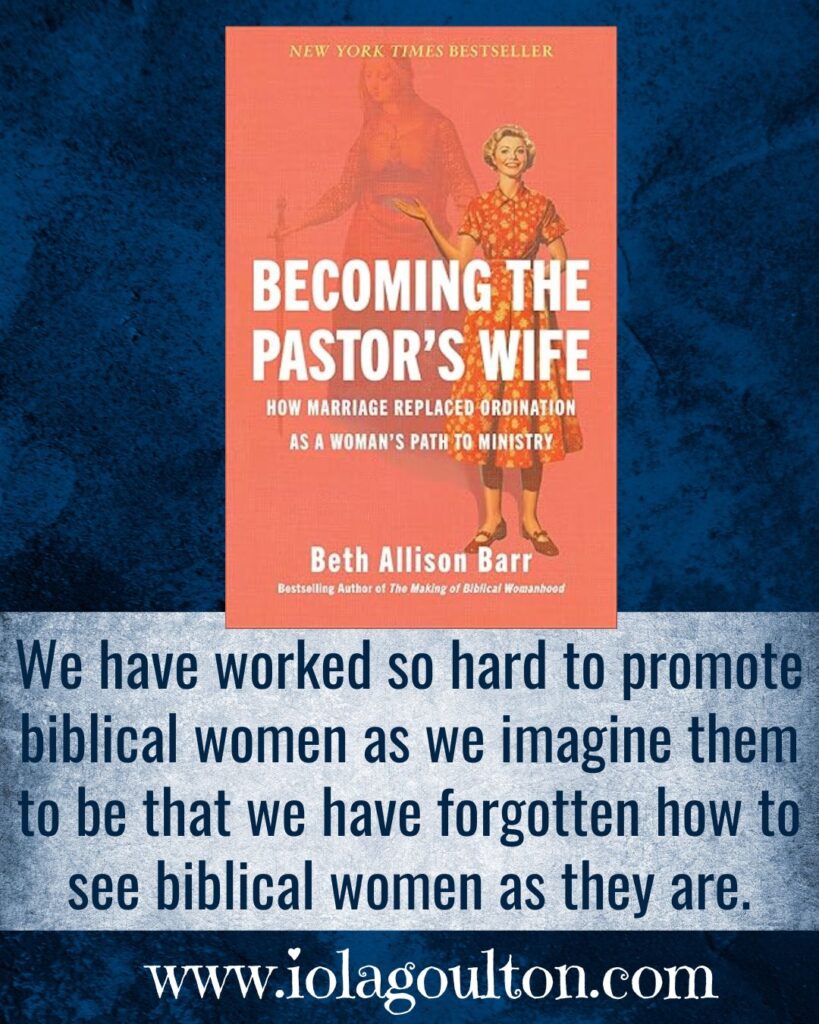
We have worked so hard to promote biblical women as we imagine them to be that we have forgotten how to see biblical women as they are.

Book Review | Becoming the Pastor’s Wife by Beth Allison Barr

As the title suggests, Becoming the Pastor’s Wife is a discussion of the role of the pastor’s wife in modern Protestant churches, with an emphasis on evangelical churches in the US, where:

“the pastor’s role is by design a two-person job in which only one person receives a salary, title, and individual position.'”

It is also an academic exploration of the history of women’s ministry:

“Becoming the Pastor’s wife is the history of how Christian women gained a new and important leadership role. But it is also the history of how this gain came at a cost for women.”

First, Dr Barr reminds us that women have always had a place in ministry (despite what some church leaders would have us believe):

“The biblical text presents female prophets leading the people of God and proclaiming the word of God unremarkably, as part of the natural order of things.”

Barr reminds us that the New Testament shows us many women prophets, including Mary the mother of Jesus (Luke 1:46-55), Anna, and the four daughters of Philip (1 Cor 11). She shows us women serving alone (Junia) or alongside their husbands (Prisca and Aquilla). Perhaps more importantly, she shows men serving alone while their wives carry on with their own responsibilities. Yes, New Testament men didn’t need their wives to support their ministry by being on stage with them.

There were Dr. Barr points out that the modern church has elevated preaching over prayer and prophesy, contrary to the emphasis in the New Testament. We’ve then used Paul to justify not allowing women to teach. (Except even the most rigid complementarian allows and even encourages women to teach the children in Sunday School … not least because men rarely volunteer for that thankless task).

“Can you imagine what would happen to arguments excluding women from pastoral authority if we recentered our definition of pastoral authority from preaching to praying?”

So what happened?

Dr. Barr points to the Fourth Lateran Council of 1215 as prompting the change. From this point, only ordained priests could lead communion. And, or course, only men could be ordained … despite a long history of women leading nunneries, including some that had women and men in separate wings (for example, Milburga leading Wenlock Priory).

Isn’t it fascinating that the church allowed Christian women to minister for 60% of the time since Jesus?

This change was predicated on the (disturbing) underlying assuming that God therefore didn’t call women to serve as anything but nuns.

No doubt helped by the fact laypeople weren’t allowed to read the Bible for themselves. Instead, they had to trust the men leading them were true shepherds … and not out to fleece them.

The Reformation changed this somewhat, but also introduced the idea of a woman ministering alongside her husband. As such, a woman’s calling was tied up with her husband’s calling.

Which implies God either didn’t or couldn’t call women to minister in their own right.

Last week, when our pastor (yes, our female pastor) asked for volunteers to distribute communion, she remined us that we believe in the priesthood of all believers. It’s a phrase I’ve heard often and have never thought much about. But, after reading Dr. Barr’s book, I realise what a radical statement it is: it reminds us that we don’t have to be an ordained (male) priest to lead communion.

And if we don’t have to be ordained by the church to lead communion, that most sacred of sacraments, nor do we have to be ordained to preach or teach or prophesy or pray. Which makes sense, given women never had to be ordained to lead children’s church, prepare communion, type the notices, clean the church, or perform any number of menial ministry tasks that have been historically left for women.

It’s not all bad news. Dr. Barr does offer hope, saying the church could be different—specifically, the Southern Baptist Church, where Barr and her husband have served for years. She ends with a set of “what if” and “can you imagine” statements that could radically change our understanding of women’s ministry in church. It could also form a bridge to the younger generation, those who see the unbiblical patriarchy embedded in the modern church and who have therefore rejected the church … and God.

Recommended for any women who have ever wondered what God has called them for and to.

Thanks to Brazos Press and NetGalley for providing a free ebook for review.

About Beth Allison Barr

Beth Allison BarrBeth Allison Barr is the U.S.A. Today’s bestselling author of The Making of Biblical Womanhood: How the Subjugation of Women Became Gospel Truth. An academic by training and a pastor’s wife by calling, Beth uses her unique voice to speak out on the relevance of medieval history to our modern world—especially concerning women in both medieval and modern Christianity. Her work is described as “smart,” “powerful,” and “a game changer” for women in modern evangelicalism.
Barr is currently the James Vardaman Professor of History at Baylor University, where she teaches both undergraduate and graduate courses, but she also speaks and writes as a public intellectual. She has been featured by NPR and The New Yorker, and her bylines include Religion News Service, The Washington Post, Christianity Today, The Dallas Morning News, Sojourners, and Baptist News Global. She also continues to write regularly on The Anxious Bench, a popular religious history blog on Patheos.

Find Beth Allison Barr online at:

Website | Facebook | Instagram | Substack

About Becoming the Pastor’s Wife

Becoming the Pastor's WifeAs a pastor’s wife for twenty-five years, Beth Allison Barr has lived with assumptions about what she should do and who she should be.

In Becoming the Pastor’s Wife, Barr draws on that experience and her academic expertise to trace the history of the role of the pastor’s wife, showing how it both helped and hurt women in conservative Protestant traditions. While they gained an important leadership role, it came at a deep cost: losing independent church leadership opportunities that existed throughout most of church history and strengthening a gender hierarchy that prioritized male careers.

Barr examines the connection between the decline of female ordination and the rise of the role of pastor’s wife in the evangelical church, tracing its patterns in the larger history (ancient, medieval, Reformation, and modern) of Christian women’s leadership. By expertly blending historical and personal narrative, she equips pastors’ wives to better advocate for themselves while helping the church understand the origins of the role as well as the historical reality of ordained women.

Find Becoming the Pastor’s Wife online at:

Amazon | BookBub | Goodreads

Don’t forget to click here to check out my Amazon shop for my top picks in Christian fiction!

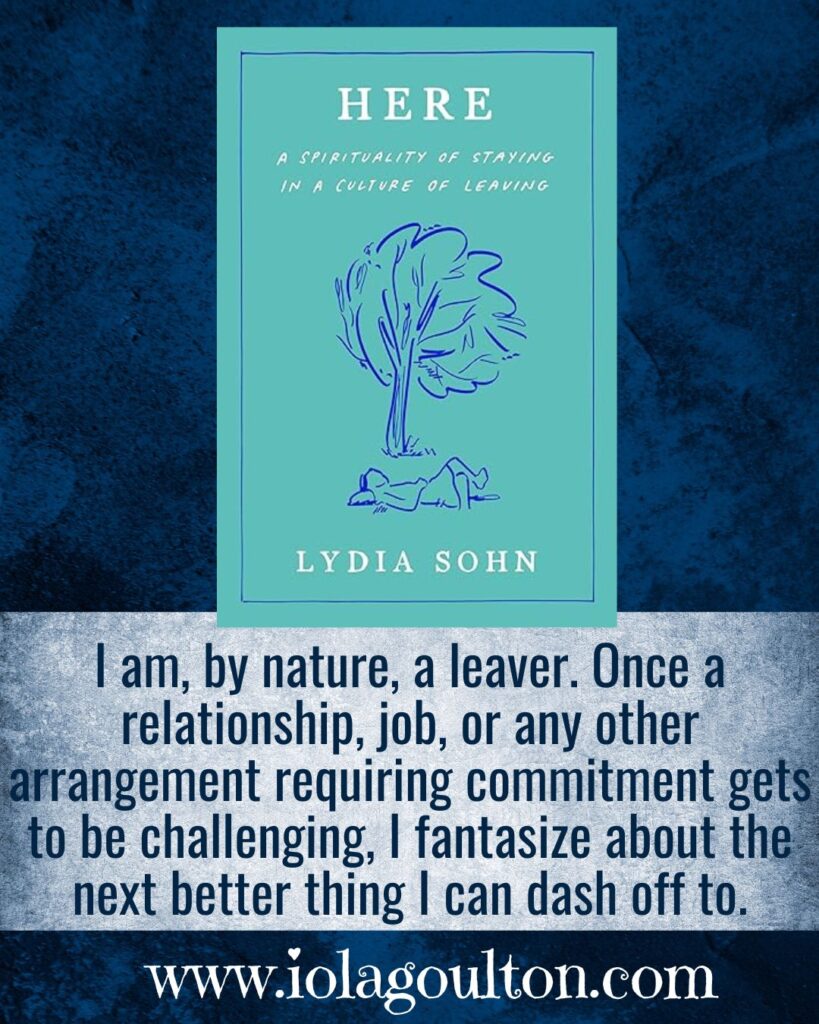
I am, by nature, a leaver. Once a relationship, job, or any other arrangement requiring commitment gets to be challenging, I fantasize about the next better thing I can dash off to.

Book Review | Here by Lydia Sohn

Part self-help and part memoir, Here is a short but powerful lesson on moving through life and attaining our goals in a traditional but possibly counter-cultural way.

One of the features of reading nonfiction, especially Christian nonfiction, is discovering more about how other people think about faith and God and living the Christian life. Some of the authors are like me; some are not.  Some of their ideas are familiar; some are not. Some of their ideas gel with me; some do not. But there is always something to ponder and learn, even when I thnk I have little in common wiht the writer.

Here by Linda Sohn is one such book. We have some things in common: we are both Christian women, working mothers, wives, and first-generation immigrants. We have differences: she lives in Los Angeles; I live in New Zealand. She is a Methodist minister; I am an evangelical turned Baptist. She describes herself as a leaver; I do not.  Sohn says:

I am, by nature, a leaver. Once a relationship, job, or any other arrangement requiring commitment gets to be challenging, I fantasize about the next better thing.

That alone makes us very different. But it’s in that difference we can learn … and possibly change our beliefs and resulting actions to become more Christlike. Sohn suggest this is because we live in a world that values leaving over staying, pointing out that we have taken journeys to escape the present or move. There is a longstanding belief that leaving one’s hometown is a marker of success and moving up in the world. Sohn points out this restlessness, this desire to leave because of external satisfaction, is not unusual.

Sohn’s premise is than instead of wondering where we should go next when we get restless, we should ask different questions:

What is it within me leading to dissatisfaction?
What can I change within myself that will influence the larger situation?

Here is a statement of the power of staying where we are planted, the self-discipline that requires when all we want to do is leave, and an examination of a range of Christian spiritual disciplines. She also points out that these disciplines will lead to our transformation … so we can change even while remaining here (wherever “here” may be).

Here is a quiet yet compelling book, one that encourages us to explore a range of spiritual practices, including meditation and prayer, spending time in nature, expressing gratitude, spiritual contemplation (reading the Bible), self-reflection, and communal worship.

It’s a book that’s packed full of wisdom. Wisdom Sohn herself has gleaned over the years. Wisdom from spiritual giants of the past. Wisdom from not-so-spiritual giants of today. You won’t agree with everything she says, but it will make you think. And it could inspire you to decide to make a change for good.

Thanks to Convergent Books and NetGalley for providing a free ebook for review.

About Here

A Spirituality of Staying in a Culture of Leaving

A contemplative guide to finding satisfaction right where you are, by understanding what it is within us that leads to dissatisfaction and creating long-lasting fulfillment—inspired by the ancient Christian tradition of Benedictine stability.

Here: A Spirituality of Staying in a Culture of Leaving by Lydia SohnLydia Sohn was a serial burn-it-down-and-make-a-fresh-start girl until, when in her late twenties, she encountered the Rule of St. Benedict with its vow of stability, and her world was transformed. Sohn took a pause to consider what she wanted out of life—identity, purpose, community—and had a lightbulb moment: Everything she needed to live the life she desired was already within her reach.

Here
 pushes back against our age of constant reinvention and the cultural message that we should do whatever it takes to get wherever we want to go. Instead, Sohn’s message is the opposite: stay. Stay and cultivate the immense potential and beauty that currently lies dormant within your circumstances.

Sohn understands the allure of nomadism. A nomadic life would protect us from the stress of relational conflicts that inevitably arise when we’re caught in the intricate web of commitments. But the restlessness, FOMO, and disappointment we’re trying to escape always come along for the journey. That’s because they’re not the result of our circumstances; they reside within us.

Braiding personal narrative and spiritual reflection, Here inspires readers to both embrace and transform their circumstances through commitment and stability—in order that they might find true contentment right where they are.

Find Here online at:

Amazon | BookBub | Goodreads

About Lydia Sohn

Rev. Lydia Sohn is a United Methodist minister, currently serving as senior pastor of Walnut United Methodist Church, and a writer whose work has appeared in The New York TimesThe Atlantic, and The Christian Century, among other venues. She lives in Claremont, California with her husband and three children.

Find Lydia Sohn online at:

Website | Facebook | Instagram

What was your last five-star read?

Bookish Question #341 | What was your last five-star read?

This question was harder to answer than it should have been.

I read a lot of books. And the more books I read, the harder it is to find stories that stick in my memory after I’ve closed the book (or switched off the Kindle.

The title that sprang to mind for this question isn’t a book I’d normally read, but I’ve seen it mentioned online and have been waiting for it to come on sale on Kindle. Then I saw it at my local library, so checked it out.

It’s not fiction.
It’s not Christian (although the author is a Christian).
It’s nothing like the books I usually read and review.

It’s Jesus and John Wayne by Kristen Kobes Du Mez

(which I did recently feature in a First Line Friday post).

Jesus and John Wayne is probably best described as a history textbook, showing how the modern church has, step by tiny step, morphed the collective understanding of Jesus from the man who healed the sick and ate with sinners to some kind of nationalistic patriarchal authoritarian who was the opposite of politically correct.

Like John Wayne.

Yet Jesus was nothing like John Wayne. Jesus stood up for women, for widows (the single parents of his day), for orphans, for the oppressed, for the immigrants, the refugees (Jesus himself was a refugee in Egypt).

Du Mez makes a compelling argument for how the US Christian church has come to misinterpret Jesus by conflating him with people like John Wayne, and how that has hurt the church in the USA (I would add that it’s hurt the church globally).

You might not agree with everything she says, but it’s a well-researched and strongly written case, and well worth taking the time to read.

It might just make you think.

What about you? What’s your most recent five-star read?

A discipline is any activity I can do by direct effort that will eventually enable me to do what I cannot currently do by direct effort.

Book Review | Practicing the Way by John Mark Comer

John Mark Comer posits that Christianity should be more than praying a salvation prayer. It should also be a way of living. In Practicing the Way, Comer offers practical, Biblical suggestions as to how Christians can become true disciples—apprentices—of Jesus.

The book is structured in four parts.

In the first, Comer takes readers through the rabbinical tradition of disciples, pointing out that “disciple” is a noun, not a verb i.e. we are (or aren’t) disciples of Jesus. He also suggests that “apprentice” might be a better translation, because an apprentice is responsible for learning.

Comer argues that the accountability is on us listening to Jesus and learning, rather than putting the accountability on the teacher to teach (which turns “discipling” into adverb, an action that is performed on us).

He then moves onto three goals for disciples: to be with Jesus, to become like Jesus, and to do as He did.

But how? Here Comer builds on some of his suggestions and insights from his previous book, The Ruthless Elimination of Hurry, and suggests some oh-so-logical ideas that are oh-so-easy to resist: ideas like having a digital Sabbath once a week, and to have daily no-phone times.

Comer also emphasises that we can’t let our practices become our faith.

The point of spiritual practices is to bring us closer to God, not to turn our faith into a set of rules for the sake of rules (something I see as I grow older: one person has a personal rule they find helps them grow closer to God, such as not reading novels or not using their phones on Sunday, and others turn this into a Rule they say everyone must live by in order to be a “proper Christian”. This is a “Jesus plus” gospel, where outward appearance and action takes precedence over the heart attitudes … instead of outward actions reflecting our heart attitudes).

Discipline is a means to an end—to be with Jesus, become like him, and do what he did. But Comer is refreshingly realistic: he recognises that we all need limits.


You must name your limits—and from there determine what you honestly can do, and then, let that be enough.

Comer’s Christianity is the opposite of hustle culture and the more-more-more of modern life (and, often, of modern church). Instead, it’s less:

For most of us, it’s ... important to focus on what we’re not going to do, to build margin into the architecture of our lives.

In other words, we have to learn how to say “no” to people if we’re going to have the capacity to say “yes” to God.

I got a lot out of reading Practicing the Way. It’s easy to read, yet jam-packed with Christian wisdom and solid ideas on how to turn the ideas into actions. I will no doubt need to re-read it in a few months … perhaps right after I re-read The Ruthless Elimination of Hurry.

Recommended.

Thanks to Waterbrook and NetGalley for providing a free ebook for review.

About John Mark Comer

John Mark Comer is the New York Times bestselling author of Practicing the Way, Live No Lies, The Ruthless Elimination of Hurry, and four previous books. He’s also the Founder and Teacher of Practicing the Way, a simple, beautiful way to integrate spiritual formation into your church or small group. Prior to starting Practicing the Way, he spent almost twenty years pastoring Bridgetown Church in Portland, OR, and working out discipleship to Jesus in the post-Christian West.

Find John Mark Comer online at:

About Practicing the Way

We all have experienced unwanted parts of our spiritual journey: distance from God, gaps in our character, the fear that our lives will be trivial and empty… Jesus is calling us into more. Calling us to be shaped in his likeness. To experience his abundance of life.

But how, practically, can we do that? By becoming his apprentice. By practicing the Way.

Outlining the timeless process of being with Jesus, becoming like him, and living as he did, bestselling author and pastoral voice John Mark Comer delineates God’s vision for the journey of our soul.

In this powerful and practical work, he defines his core philosophy of spiritual formation to help us form a “rule of life.”

Along the way, readers benefit from his rich cultural insight, deep biblical teaching, and honest and hopeful view of the potential of each human soul.

You feel like there’s more to life than this? You’re right. Now come discover just how much life awaits you.

Find Practicing the Way online at:

Amazon | BookBub | Goodreads

First Line Friday

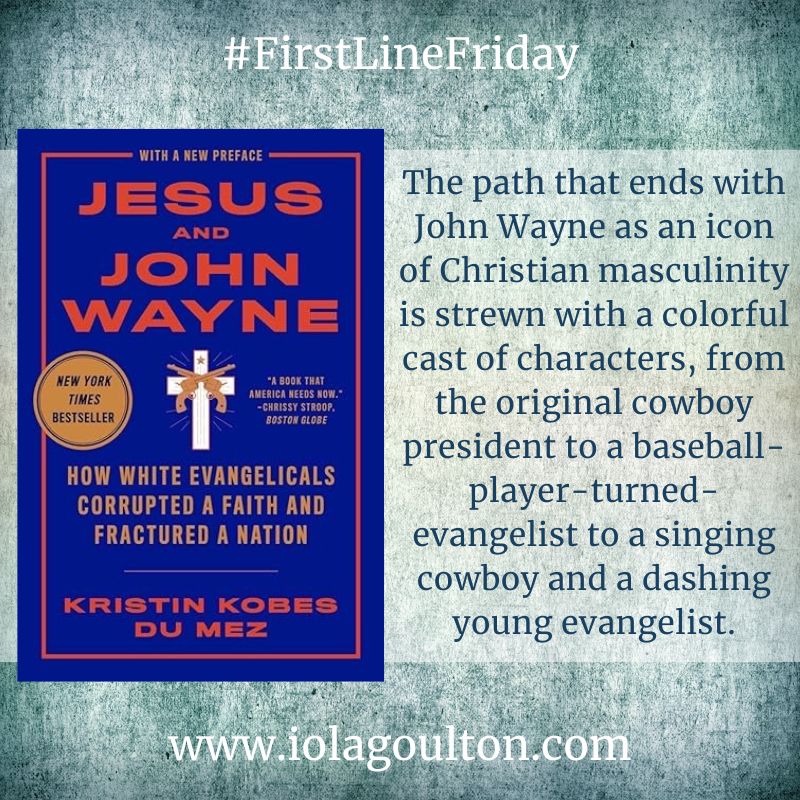
First Line Friday #343 | Jesus and John Wayne by Kristen Kobes Du Mez

It’s First Line Friday! That means it’s time to pick up the nearest book and quote the first line.

I’ve recently joined the local library, so this week I’m reading a book I found in the library that’s been on my to-read list since it released: the eye-opening Jesus and John Wayne by scholar Kristin Kobes Du Mez.

Here’s the first line from the Chapter One:

The path that ends with John Wayne as an icon of Christian masculinity is strewn with a colorful cast of characters, from the original cowboy president to a baseball-player-turned-evangelist to a singing cowboy and a dashing young evangelist.


What’s the book nearest you, and what’s the first line?


About Jesus and John Wayne

Jesus and John Wayne is a sweeping, revisionist history of the last seventy-five years of white evangelicalism, revealing how evangelicals have worked to replace the Jesus of the Gospels with an idol of rugged masculinity and Christian nationalism―or in the words of one modern chaplain, with “a spiritual badass.”

As acclaimed scholar Kristin Du Mez explains, the key to understanding this transformation is to recognize the centrality of popular culture in contemporary American evangelicalism. Many of today’s evangelicals might not be theologically astute, but they know their VeggieTales, they’ve read John Eldredge’s Wild at Heart, and they learned about purity before they learned about sex―and they have a silver ring to prove it. Evangelical books, films, music, clothing, and merchandise shape the beliefs of millions. And evangelical culture is teeming with muscular heroes―mythical warriors and rugged soldiers, men like Oliver North, Ronald Reagan, Mel Gibson, and the Duck Dynasty clan, who assert white masculine power in defense of “Christian America.” Chief among these evangelical legends is John Wayne, an icon of a lost time when men were uncowed by political correctness, unafraid to tell it like it was, and did what needed to be done.

Challenging the commonly held assumption that the “moral majority” backed Donald Trump in 2016 and 2020 for purely pragmatic reasons, Du Mez reveals that Trump in fact represented the fulfillment, rather than the betrayal, of white evangelicals’ most deeply held values: patriarchy, authoritarian rule, aggressive foreign policy, fear of Islam, ambivalence toward #MeToo, and opposition to Black Lives Matter and the LGBTQ community.

A much-needed reexamination of perhaps the most influential subculture in this country, Jesus and John Wayne shows that, far from adhering to biblical principles, modern white evangelicals have remade their faith, with enduring consequences for all Americans.

Find Jesus and John Wayne online at:

Amazon | BookBub | Goodreads

Click here to check out what my fabulous fellow FirstLineFriday bloggers are sharing today.

And you can click here to check out my previous FirstLineFriday posts.

Share your first line in the comments, and happy reading!

Don’t forget to click here to check out my Amazon shop for my top picks in Christian fiction!


First Line Friday

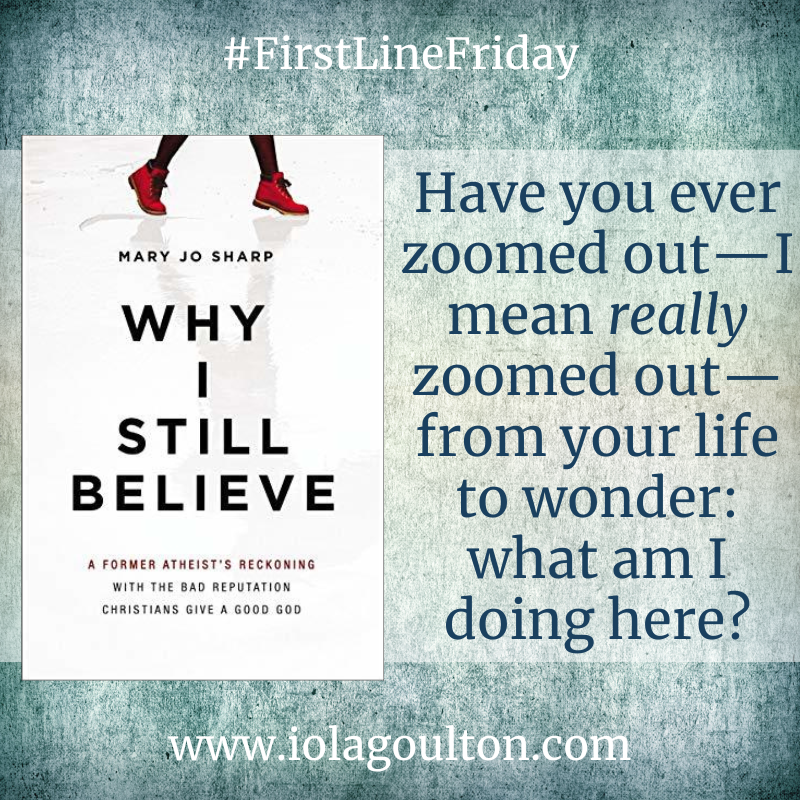
First Line Friday #266 | Why I Still Believe by Mary Jo Sharp

It’s First Line Friday! That means it’s time to pick up the nearest book and quote the first line.

Today I’m sharing from Why I Still Believe: A Former Atheist’s Reckoning with the Bad Reputation Christians Give a Good God by Mary Jo Sharp. I’m not a big nonfiction reader, but picked this up because I’m always interested in understanding why people become Christians (especially as adults), and how we can deal with hypocrisy.

Here’s the first line from the Chapter One:

Have you ever zoomed out—I mean really zoomed out—from your life to wonder: what am I doing here?

What’s the book nearest you, and what’s the first line?


About Why I Still Believe

For anyone who feels caught in the tension between the beauty of God’s story and the ugliness of human hypocrisy, Why I Still Believe offers a stirring story of hope.

Why would anyone be a Christian when there is so much hypocrisy in the church? Mary Jo Sharp shares her journey as a skeptical believer who still holds to a beautiful faith despite wounding experiences in the Christian community.

At a time when de-conversion stories have become all too common, this is an earnest response – the compelling conversion of an unlikely believer whose questions ultimately led her to irresistible hope. Sharp addresses her own struggle with the reality that God’s people repeatedly give God’s story a bad name and takes a careful look at how the current church often inadvertently produces atheists despite its life-giving message.

For those who feel the ever-present tension between the beauty of salvation and the dark side of human nature, Why I Still Believe is a candid and approachable case for believing in God when you really want to walk away. With fresh and thoughtful insights, this spiritual narrative presents relevant answers to haunting questions like:

  • Isn’t there too much pain and suffering to believe?
  • Is it okay to have doubt?
  • What if Jesus’ story is a copy of another story?
  • Is there any evidence for Jesus’ resurrection?
  • Does atheism explain the human experience better than Christianity can?  
  • How can the truth of Christianity matter when the behaviors of Christians are reprehensible?

At once logical and loving, Sharp reframes the gospel as it truly is: the good news of redemption. With firmly grounded truths, Why I Still Believe is an affirming reminder that the hypocrisy of Christians can never negate the transforming grace and truth of Christ.

Find Why I Still Believe online at:

Amazon | BookBub | ChristianBook | Goodreads

Click here to check out what my fabulous fellow FirstLineFriday bloggers are sharing today.

And you can click here to check out my previous FirstLineFriday posts.

Share your first line in the comments, and happy reading!

Don’t forget to click here to check out my Amazon shop for my top picks in Christian fiction!