Category: Bookish Question

Which author would you like to invite to dinner?

Bookish Question #188 | Which author would you like to invite to dinner?

Tough question.

I could say one of the writers of the Bible, like Moses or David or Paul or John. But I won’t, because I figure we’ll have time in eternity to debate what Moses really thought about Pharaoh, or what John really saw in that cave in Patmos and would he describe it differently if he knew about modern technology.

I could say any one of many of my favourite Christian authors, alive with us or alive with Jesus. But again, I figure there will be time in eternity to discuss books with booklovers (because surely all authors are also booklovers?).

I could say Arthur Randsome or Enid Blyton or Anne Digby or one of many favourite authors from my childhood.

Or I could say any of the wonderful authors I’ve met at the conferences I’ve attended in New Zealand and Australia (although I actually have had the opportunity to share a meal with many of them).

So how do I choose? Who would I like to invite to dinner?

I’d like to invite the not-yet-published author who doesn’t know if their story is good enough. If their writing is good enough. If they are good enough.

I’d like to encourage them that while we should all pursue excellence in our writing, its not about being good enough. As Christian writers, it’s about about being obedient to God’s call on our writing life. It’s about writing and publishing what he’s called us to. And it’s about being part of a community of writers—Christian or not—to learn from and share with, to receive encouragement from and to encourage.

So that’s who I’d want to invite to dinner: the writer or author who needs a little encouragement.

What about you? Which author would you like to invite for dinner, and why?

What do you like to read about in author newsletters?

Bookish Question #186 | What do you Like to Read About in Author Newsletters?

My favourite author newsletters are ones that are more than just a sales pitch.

What do I like?

I like to know a little bit about the author’s life.

Because I don’t want a day-by-day diary (especially not if their life is as boring as mine), but enough that they are more than a paragraph on the back cover of a novel.

I like something funny.

Because I like authors with a sense of humour who aren’t afraid to show it.

I like short.

Because long newsletters leave me feeling I’d rather be reading one of their novels.

Some of the author newsletters i read have a predictable pattern, which I like. One newsletters has a 3-2-1 pattern—three topics, with three points about the first, two about the second, and one about the last. One  newsletter always ends with a short prayer.

Some authors share favourite books and authors, which I like.

What I like less is when authors promote other authors without having read their books first—I’ve had more than one bad experience in buying a book recommended by an author in their newsletter, and now I’m sceptical.

What I don’t like with author newsletters is receiving them too often.

Yes, it’s fine for authors to send more than one newsletter to announce a new book launch, but some authors seem to ramp up to a newsletter every day when they are launching. That usually has me hitting the unsubscribe button: if I’ve already bought the book, I don’t need to be asked again. If I didn’t buy it the first three times I’m emailed, I’m not likely to buy it the next ten times either.

I like knowing which books my favourite authors are reading and enjoying. I like knowing what they’re working on. And I like knowing a bit about the author’s life and where they live.

What about you? What do you like to read about in author newsletters?

Do you read author newsletters?

Bookish Question #185 | Do You Read Author Newsletters?

Author newsletters are part of the standard marketing package for savvy authors.

They are more reliable than social media, in that authors can be pretty sure the email will end up in the reader’s email inbox.

I’ve signed up to a lot of author newsletters over the years, and unsubscribed from most of them.

I know. That’s not what the authors want.

But I see unsubscribing as doing the author a favour for two reasons:

  1. Most authors have to pay a mailing list provider to send their emails, and the cost usually depends on the number of people they have in their email list. If I’m on their list but never open their emails, I’m actually costing them money.
  2. Open rates can affect email deliverability. If I never open their email, then that could lead to their mailing list provider to start sending their emails to spam or junk. If I’m on their list but never open the emails, I might be affecting their ability to send emails to their genuine fans.

I signed up to a lot of email lists as a result of free promotions i.e. the author gives away a free ebook if you sign up to their email list.

I often sign up as a low-risk way of finding new authors to read.

If I read and enjoy their free book, I’ll usually stay on their email list. If I don’t like the book—or if the author’s emails are too boring, to salesy, or arrive too oftethen I’ll usually unsubscribe.

The newsletters I’m most likely to read tend ot be short and have some personality–they show a little it of the author and their life. They’re not just about selling books. They don’t come too often (weekly or monthly is great. Daily is too often). And they’re not too long.

And on that note, I’ll stop before I go on too long!

What about you? Do you read author newsletters?

Do you participate in online author groups?

Bookish Question #184 | Do you participate in online author groups?

I’m part of several active Facebook groups for authors (as well as a few for readers).

I’m also a member of dozens of Facebook groups for authors which I never visit because they are nothing but havens for post-and-run spammers. I should probably do myself a favour and leave the groups, I forget I’m in the groups because I never see the posts.

Off topic, but that’s one reason (of many) why it’s not a good idea to spam Facebook groups: no one will see the posts, so what is the point?

Anyway, it won’t surprise you to hear my favourite Facebook groups are the ones where the admins keep a tight lid on spam. In fact, “no spam” is a rule in all the groups I’m admin for.

Off topic again: it always amazes me how many so-called writers can’t read group rules that say things like “no links” or “no self-promotion” or “no spam”. Either they can’t read the rules, or they think they’re above the rules. Why else would you spam a group that forbids spam, or post links in a group that says no links?

Several of the writer groups I’m in are member-only groups i.e. only paid members of a specific writing organisation or paid training course can join the group. Those are some of the most useful.

Others are general groups that anyone can join, as long as they agree to the group rules (e.g. no spam).

My favourite groups are:

Australasian Christian Writers

Christian writers (and readers) from Australia, New Zealand, and around the world. An excellent place to ask questions and get advice that’s not US-centric.

Christian Writers Downunder

The first online author group I connected with, thanks to Paula Vince inviting me.

International Christian Fiction Writers

In this group “international” means “not from the USA”, because it’s important to know there is more to Christian fiction than the books published by the major US-based publishers.

SPF Community

A free group by Mark Dawson of Self Publishing Formula. He also has paid groups of those in his paid courses. This isn’t a Christian group so the content is sometimes a little more adult, but Mark is one of only a handful of writer coaches who earns more from writing and publishing than from teaching. As such, he is walking the talk rather than talking the walk.

Association of Christian Writers

Yes, another ACW. This one is a writing group for British Christians, and they allow non-members to join their Facebook group.

Christian Authors and Writers

The biggest group I’m a member of, and which has a lot of new writers and unpublished Christian authors.

Strengths for Writers

Author and Gallup-certified Strengths coach Becca Syme discusses the application of Gallup Strengths for writers … and for life in general). If you’ve every wondered “why do I find it hard to …”, then Becca has the answer.

Each group serves a different purpose.

Some allow me to learn, some allow me to teach, some allow me to connect. All are important.

I’m also a member of many reader groups … but that’s a topic for a different post.

What about you? Do you participate in online author groups?

Have you read more or less books than planned in 2021?

Bookish Question #183 | Have you read more or less books than planned?

We’re halfway through 2021 already (and I’m sure it’s a sign of age that the years are going faster and faster).

It’s been a busy six months, and the last few weeks have been beyond hectic. It’s “the season” at work, which means my three-day-a-week job has morphed into four days in a good week, and six in a less-good week.

As such, I haven’t had as much time for reading as usual. When I do finish work, I find my brain is often so fried that I can’t concentrate on anything longer than an email or blog post. This has definitely affected the number of books I’ve read. I’ve managed to keep on top of my reviewing list (well, I’ve managed to read them. Writing and posting the reviews isn’t going so well).

I volunteered to judge a couple of writing contests, and I’ve managed to get those books read and the scoresheets back to the organisers in good time. It’s a small win, but I’ll take it.

But my reading for pleasure has really fallen by the wayside.

According to Goodreads, I have read:

  • 45 books in total (against a target of 150)
  • 15 books off my to-Read list (against a target of 48)
  • 2 writing books (against a target of 12)

As you can see, I have a way to go … and possibly some books to check off as read. But “the season” will be over soon, and hopefully that means I can go back to a shorter work schedule and more time (and brain space) to read.

How about you? Have you read more books than planned, or are you also playing catch-up?

What's your view on chapter titles in fiction?

Bookish Question #182 | What’s Your View on Chapter Titles in Fiction?

Chapter Titles in Fiction—Love, Loathe, or Ignore?

Most of the books I read are on Kindle, and the Kindle book often defaults to opening at Chapter One. As such, I don’t see the Table of Contents to know whether there are chapter titles or not (although I suspect not).

It’s therefore a surprise when I do see chapter titles.

As it happens, I saw this question on Twitter this week. Most of the respondents seemed to like chapter titles … but they were also authors who used chapter titles. I’m not convinced that was an unbiased sample.

Personally, I’m not a fan.

Why not? Because too often, the chapter titles feel like they are telling me what’s going to be in the next chapter.

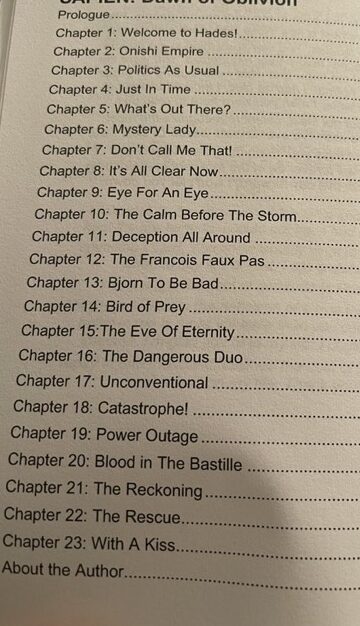
Here’s an example (from the Twitter thread I read):

Table of Contents with Chapter Titles that tell the whole story

While there are a couple of clever chapter titles, some are too obvious and “telling” what’s going to happen. It almost looks like a copy of their beat sheet (a tool some writers use in planning their novel). I can see that being useful for authors.

I’m not so sure it’s great for readers.

I can see this being useful in children’s fiction, especially for parents or teachers who are reading aloud to children. Having a “spoiler” chapter title give the reader an idea of what is coming so they can choose to stop reading at an appropriate time.

As an adult, it feels childish. After all, why read the book if I can get the essence of the story by reading the Table of Contents?

I know some authors use chapter titles when writing, both to remind them what they’ve already written and to act as a prompt for what should happen in the next scene or chapter. But they typically get deleted during editing.

It’s hard to come up with good chapter titles. If they’re not needed, why bother? Why not spend that time and creative effort on polishing the writing instead?

Overall, I either ignore chapter titles, or loathe them.

What about you? Are you a fan of chapter titles in fiction?

If so, can you suggest a novel where the chapter titles enhance the story?
Can you be enticed to impulsively buy books?

Bookish Question #181 | Can you be enticed to impulsively buy books?

Can I be enticed to impulsively buy books?

Is this a trick question?

Of course.

Why? Because I’m a reader.

I love reading. I love escaping to a world inside my head, aided and guided by the imagination of a skilled author. I love learning about people and places, and reading fiction is an easy way to learn (which is one of the reasons I dislike fiction that isn’t factually accurate).

The best way to entice me to impulse buy a book or books is to have a sales. Authors rave about those BookBub ads for a reason: because people like me buy the books. It’s hard to pass up a 99 cent book that’s on my wish list!

Another way to get me to buy a book is for the author to write a great book, and for a trusted friend to recommend that book to me. This could be in person, or through a book review.

The final great way to entice me to impulse buy a book is to have a paper copy on sale at a writing conference. I especially like the Omega Writer’s Conference in Australia, where the bookstall has been known to offer to post our purchases for us, so we don’t have to worry about annoying details like weight limits on flights.

But all these enticements only work if I like the look and sound of the book.

This means having an eye-catching cover, an intriguing title, and compelling back cover copy. A killer first line is also a help, especially if I’m flicking through a paper copy. And, of course, the price has to be right. I’m not prepared to pay more than about USD 5.99 for an ebook (and I’m a sucker for 99 cent ebooks), but I will pay NZD 25 to NZD 30 for a paperback … especially if it’s a book I’ve worked on.

What about you? Can you be enticed to impulsively buy books?

Do you like reading novels with royalty themes?

Bookish Question #180 | Do you like reading novels with royalty themes?

Yesterday was the annual Queen’s Birthday holiday in New Zealand and parts of Australia, a day off work to observe the official birthday of HM Queen Elizabeth II. Her actual birthday is in April, so I don’t know why we celebrate it in June. As a child, I was told it was because June was summer in England. That’s true, but the English don’t have a holiday in June, so why do we?

Anyway, that raises this week’s question: do you like reading novels with royalty themes?

I have to say yes and no.

I don’t mind reading speculative fiction with made-up royal characters.

After all, made-up royal characters fit with a made-up world and made-up religion. It’s always interesting to see how authors create their worlds, cultures, and religions. Royalty is often a part of that. And it’s almost to be expected in Christian speculative fiction, with themes of God as King of Kings and Lord of Lords, and us as His adoptive children–which makes us all princes and princesses.

I also don’t mind reading fictionalised versions of real, historical events involving royalty.

Having said that, I have read rather too many novels about the Tudors in particular and English royalty in general, and I’d welcome good fiction—especially Christian fiction—that showed royalty from other countries.

However, I’m not a big fan of contemporary fiction (especially romance) featuring royal families.

I’m not interested in fictionalised versions of the lives of still-living people—I haven’t even watched The Crown. I’m also not interested in made-up contemporary royal families, perhaps because the lives of our real royal family have more than enough drama.

What about you? Do like reading novels with royalty themes?

Do you have a favourite place to read?

Bookish Question #179 | Do you have a favourite place to read?

I first asked this question three years ago. I checked my answer from back then, and found it hasn’t changed. I guess that means I’m a creature of habit.

Where is my favourite place to read?

Short answer: anywhere.

Slightly longer answer: anywhere I can find where no one is talking to me.

Longer answer: I read in three main places depending on the time of day and time of year, so I guess they are my favourite places to read.

On summer days I like to read at the beach or in the back garden while I’m soaking up the sun. This is where the Kindle is great, because I can still read while lying on my back. The backlit screen means I can also read in direct sunlight (which you can’t do with an iPhone).

In winter I move into the spa pool (hot tub) and drag out the print books.

I don’t want to ruin a print book by dropping it in the water, but at least it’s still readable when it dries. A Kindle might not recover, and I’m not willing to take that risk. I know some people read on their Kindles in the bath or in the hot tub—they put it in a ziploc bag. I’m not that confident!

The rest of the time I tend to read in my favourite easy chair in the lounge, usually while my husband watches sport on TV. I find it easy enough to follow a game of rugby or cricket at the same time as reading a book. Watching a movie takes a little more skill, especially if he’s watching a foreign film. In a way, foreign films are best for reading to, because it’s easy to tune out background noise in a foreign language.

What about you? Where is your favourite place to read?

Do you like reviewing or recommending favourite books?

Bookish Question #178 | Do you like reviewing or recommending favourite books?

If so, how do you spread the word?

If you’ve been reading this blog for longer than thirty seconds, you’ll know I like reviewing and recommending favourite books.

I started reviewing books when I lost my job during the last recession and the family budget didn’t support my book-buying habit any more (I also used my local library). Anyway, I got an e-reader and discovered NetGalley at about that time, and learned publishers would send free ebooks if I promised to review them. I became a keen ebook reader and promoter. I’m also now a Kindle convert who only reads paper books if there is no other option.

I share my reviews here on my website, and review occasionally on two other sites: Australasian Christian Writers and International Christian Fiction Writers. I share my reviews (and favourite book quotes) on Facebook, Instagram, Pinterest, and Twitter. I find I get the best interaction on Instagram, probably because it’s easy to doubletap to Like a post, and posts don’t get lost the way they do on Twitter.

I will also recommend books to friends, although that relies on knowing what they’d like … and them having not already read them! 

What about you? Do you like reviewing or recommending your favourite books? How do you spread the word?