Category: Bookish Question

Do you have a favourite nonfiction Christian author?

Bookish Question #390 | Do you have a favourite nonfiction Christian author?

I don’t read a lot of nonfiction, Christian or otherwise—apart from the Bible.

If we’re going to count the Bible, then my favourite author would be Luke, who wrote the gospel of Luke and the Book of Acts (I considered saying St. John, then remembered he’s also responsible for Revelation … so maybe not).

My Kindle says I’ve only read one nonfiction Christian book this year, Here by Lydia Sohn. I enjoyed it, but one book from an author isn’t really enough to make them a favourite.

(I have read more nonfiction than just one book so far this year, but the others were library books, and not Christian.)

I love Becca Syme’s books about writing (and not writing). Becca is a Christian, but her books are written for writers regardless of their faith so they don’t really count for this question either.

My other favourite possibly doesn’t count because he is a prolific and respected author and Bible teacher, I haven’t actually read any of his books yet (although I do have a couple on my to-read pile). I got to know him through his podcast, Ask N T Wright Anything, where NT (Tom) Wright grapples with listener questions about the issues of our time.

So my answer is John Mark Comer. In The Ruthless Elimination of Hurry and Practicing the Way, Comer encourages us to slow down and live the life God wants us to life. This means consciously avoiding the rush-rush-rush do-do-do that can lead to feeling disconnected from God, and slow down and connect.
What about you? Do you have a favourite nonfiction Christian author?

Do you have any recommendations for a devotional book?

Bookish Question #389 | Do you have any recommendations for a devotional book?

I’m not a big reader of devotional books.

I try, but I tend to start books at the beginning and read through to the end. That works for fiction and even for most nonfiction, but it doesn’t work for a devotional book where the idea is to read a page a day for 30 or 52 or 365 days.

I appreciate they have a place in the market and in the Christian life. Each devotional takes only a few minutes to read so would be ideal for, say, busy mothers, or for people to read on their daily commute (only if they commute on public transport, of course. Please do not read while driving!)

These days, I’m more likely to share a devotional that’s been posted online, such as the Monday devotional posts on Australasian Christian Writers, or the many people who share their thoughts on Facebook.

What about you? Do you have any recommendations for a devotional book? Why do you recommend that book?

Do you read devotional books?

Bookish Question #388 | Do you read devotional books?

Yes and no …

I have started many devotional books, but I don’t think I’ve ever finished one.

I like to pick a book up and read it from start to finish, whereas devotional books are designed to be read a page at a time.

I also don’t like the fact that devotional books start with a Bible reading, but don’t include the full reading. I understand that is for copyright reasons, but it’s another reason I don’t finish the devotional book. It tells me to read Romans 8:1-11 (for example), but I keep reading and go off on my own tangent. If I remember to come back to the devotional, it’s inevitably focusing on something completely different than the verse or passage that grabbed my interest.

I have tried, over and over.

I keep getting to day four or day seven or day fourteen, then getting distracted and not picking the book up again.

The only exception is one-year devotionals which are a read-the-Bible-in-a year challenges. With these, it doesn’t matter if you read ahead a few chapters or even a whole book, because you were going to read that anyway.

What about you? Do you read devotional books? What do you recommend?

Are there any occupations you would like to see in Christian fiction?

Bookish Question #386 | Are there any occupations you would like to see in Christian fiction?

Great question.

Christian fiction (and perhaps all fiction) seems to go through stages. It seems that most fiction I read features cowboys, cafe owners, bookshop owners, or B&B owners. (And it’s almost always the owners, not the workers.)

I see a handful of accountants and a few marketing executives, but I don’t think I’ve ever seen a Human Resources manager or business analyst. I’ve never read a Christian novel featuring an auditor or an actuary. I’ve seen a few winery owners, but never seen a publican (which perhaps is less surprising than the winemakers.)

I see very few stories set in big businesses or government departments.

Even billionaire romances tend to feature heroes (and they are almost always heroes) who spend little of their time in the office. And when I see government employees, they tend to be law enforcement, teachers or medical professionals(because outisdethe USA,most medical professionals are government employees).

When I do see businesspeople, the story typically mentions their occupation, but everything happens outside this office. This does make sense: most businesses, especially large businesses have strict rules about relationships between colleagues.

So what occupations would I like to see?

Honestly, I’d like a good workplace romance where the woman is the boss or where the man is the one who sacrifices his career for love.

What about you? What occupations would you like to see more of in Christian fiction?

What themes would you like to see more of in Christian fiction?

Bookish Question #385 | What themes would you like to see more of in Christian fiction?

This is an interesting question.

The genres and themes I’m interested in change over time, perhaps as my life circumstances change.

What I am always interested in is Christian fiction that explores some of the harder questions while still delivering an enjoyable story.

What I don’t want to read are stories that are so obviously Delivering An Important Message that they forget readers are looking for readable writing, likeable characters, and an entertaining story (or is that just me?)

This is particularly an issue in the Christian fiction market.

Christian where authors can forget they’re writing a novel and start preaching. Usually they are preaching the gospel of Jesus Christ, but I’ve also read books preaching the importance of recycling, the right to bear arms, and how it’s important for mothers to not work outside the home when they have children.

(That one really annoyed me, as the couple moved in with mother-in-law to help save the farm, and mother-in-law insisted the heroine should give up her job when Granny could have helped with childcare and allowed the heroine’s salary to cover all their household expenses while husband worked the farm).

And now I’ve forgotten the question…

That’s right. What themes do I want to see more of?

I guess I just want to see well-written stories with likeable characters who don’t have perfect lives, but who overcome their challenges by walking with God.

What about you? What themes would you like to see more of in Christian fiction?

Do you remember the first Christian novel you read as an adult?

Bookish Question #384 | Do you remember the first Christian novel you read as an adult?

Yes – in fact, it was the first Christian fiction I ever read at all.

The title?

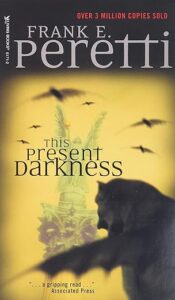
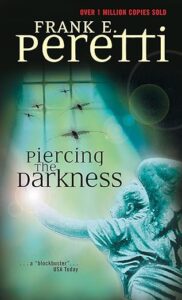
This Present Darkness by Frank Peretti.

My aunt bought This Present Darkness and Piercing the Darkness and loaned them to my mother. Mum didn’t read them, but I devoured them.

I was then thrilled to discover Christian fiction was an entire genre … and my life has literally never been the same.

What about you? What was the first Christian novel you read as an adult?

And in case you’ve never read them, here are the details:

This Present Darkness

Ashton is just a typical small town.

But when a skeptical reporter and a pastor begin to compare notes, they suddenly find themselves fighting a hideous plot to subjugate the townspeople―and eventually the entire human race.

A riveting thriller, This Present Darkness offers a fascinating glimpse into the unseen world of spiritual warfare.

Buy on Amazon

Piercing the Darkness

Leaders in the realm of darkness have mounted a new attack that will create chaos and cause defeat in the human beings who claim unity with their enemy, Christ.

Readers will find themselves rooting for a most unlikely hero as her quest for inner peace exposes the most frightening war of all, the battle for the human soul. Be captivated anew as you enter the world of battling angels and demons that author Frank Peretti so masterfully uncovered in This Present Darkness.

Buy on Amazon

How do you find books set in a specific location?

Bookish Question #383 | How do you find books set in a specific location?

I thought about this question for a while, because I don’t usually look for books based on where they are set (although an intriguing setting will often entice me to pick up a new book).

However, I know a lot of readers do location-based reading challenges, so the answer to this question is important for filling in the gaps!

When I review books, I do try to include the location in my review or in the tags so I can find the book again, and I know some other reviewers do this as well (I admit I got the idea from Narelle Atkins). That helps me locate books set in specific locations again in the future, and I hope it helps other readers.

If I did need to find a book set in a specific location, I can think of three places I’d look:

1. Amazon

I would search the location name on Amazon, in the hope that authors writing in different locations would include that in their subtitle or book description.

2. The Story Chats Podcast

The Story Chats @ Inspy Romance podcast has (sadly) closed down, but the old episodes are all available through Apple Podcasts, Spotify, and YouTube. The team did a whole series of episodes on locations.

3. Avid Readers of Christian Fiction on Facebook

If all else fails (or if you want to save yourself a search), the Avids always come through with a veritable trove of suggestions, not matter how obscure your question. I am not responsible for how much your bank account will suffer should you ask.

What about you? How do you find Christian novels set in a specific location?

How do you find new-to-you authors?

Bookish Question #382 | How do you find new-to-you authors?

Back in the days before Kindle, by I found new authors by browsing in a physical bookstore – and the bookstore owner often recommended titles. Of course, that was back in the days where it was easier to find a Christian bookstore, and where the owner/operator knew the stock and the customers. I lived in a smallish city that had three Christian bookstores – now there is one.

This was why it was so difficult to be a successful author if you weren’t published by a traditional publisher who could get books into shops and libraries.

I now live in a bigger city that doesn’t have a single Christian bookstore, so even if I wasn’t a Kindle reader, I would have to become a mail-order shopper.

Now, in the era of Kindle and self-publishing, I mostly find new authors through promotions or recommendations from other authors.

My two most reliable sources are:

What about you? How do you find new-to-you authors?

Have you found any on my website? If so, let me know in the comments.
As a reader, do tropes matter to you?

Bookish Question #381 | Do tropes matter to you?

As a reader, do tropes matter to you?

I guess we need to start by defining tropes.

First, tropes are different from genre. Genre is the broad subject of a book e.g. a romance vs. a mystery vs. a thriller.

(Click here to read more about genre.)

Tropes are features within a genre.

They may describe one or more of the characters (e.g. grumpy, sunshine, billionaire, cowboy). They may describe the overall plot or conflict (friends to lovers, enemies to lovers). They may indicate the key conflict (secret baby, amnesia). They may describe the setting (small town, forced proximity).

Why do author use tropes?

Because just like readers read by genre (e.g. romance vs. mystery), many also read by trope, particularly tropes like billionaire romance or sports romance or cowboy romance.

Most readers have tropes they like and tropes they don’t like, so advertising tropes serves a dual purpose: it attracts the readers who enjoy that trope, and indicates to the readers who don’t that they might be better looking elsewhere.

Some authors signal their tropes in the book titles or subtitle.

I’m sure you’ve seen titles like The Billionaire’s Secret Baby (which turns out to be a really popular book title). I don’t mind that, although it does feel a little obvious.

Other authors stuff their subtitles with tropes: The CEO’s Companion: A Slow Burn Christian Contemporary workplace romance (BWWM). (With BWWM meaning Black woman and white man, just in case the cover image didn’t make that clear.) Predictably, the white man is the CEO boss.

I’d love to read a billionaire romance where the billionaire was the heroine. Even better if she was something other than white.

I’m not a fan of trope stuffing in the subtitle. That’s what the book description is for. I also don’t like trope-stuffing in advertisements, where the advertisement for a book that seems to have a dozen or more tropes.

I think tropes are like jewellery: less is more.

They absolutely matter, but stick to one or two and make them good.

What about you? Do tropes matter to you?

If you reply to an author's newsletter, do you expect a response?

Bookish Question #380 | If you reply to an author’s newsletter, do you expect a response?

If you reply to an author’s newsletter, do you expect a response?

Interesting question!

If I had ever written to an author back in the days before email, I wouldn’t have expected an answer. Not that I ever wrote to an author, mind you. That would have meant …

  • Finding the address
  • Writing the letter
  • Going to the post office so the letter could be weighed so I could make sure it had the correct postage for an international letter
  • Assuming the letter got correctly delivered
  • Assuming that the author read the letter
  • Assuming that the author then chose to reply
  • Assuming that the international postal service managed to get that reply back to me in New Zealand
That’s a lot of assumptions, and is probably why I wouldn’t have expected a reply.

Email and social media have made it easier and cheaper to connect. In theory, makes it easier to send and receive mail, but we are still beholden to the email service providers to deliver our email. Some email gets stuck in spam folders, and some never gets delivered at all.

Besides, email can be overwhelming.

I get work emails, life admin emails (like bank statements and bills), retail emails, author newsletter emails, and various other emails. I look at my email inbox and the emails I need to reply to, and fully understand why someone might choose not to respond.

Also, emails can turn into a never-ending train.

Author: Cool email
Reader: I enjoyed your cool email.
Author: Thank you. I’m glad you enjoyed it.
Reader: Thank you for saying thank you.
Author: Thank you for …

It could go on forever.

Someone has to stop the train, and I’m not going to object if that someone is the author.

So while it’s always nice to get a response, I don’t need one and I’m not going to hold it against an author if I don’t receive a response.

What about you? Do you expect a response if you reply to an author’s email newsletter?